
LSAT Preptest 74 LG Explanations
Full explanations for every question from the logic games section of LSAT Preptest 74.
Archived Logic Games explanations
Logic Games are no longer part of the LSAT. LSAC removed the Logic Games section beginning with the August 2024 LSAT. If you are studying for the current LSAT, you can skip this section.
These explanations remain available for students, tutors, and readers using old-format PrepTests. For current guidance, see Logic Games and the current LSAT.
Table of contents
Game 1: Band Concert
Game 1 Setup
This is an explanation of the first logic game from Section II of LSAT Preptest 74, the December 2014 LSAT.
A six-member band held a concert. The band consists of a guitarist, a keyboardist, a percussionist, a saxophonist, a trumpeter, and a violinist (G, K, P, S, T, V). Each of them performs exactly one solo. You must use the rules to determine the possible sequences of the solos.
Game Setup
This is a pure sequencing game. This type of game has been changing on modern LSATs.
If you look at older LSATs, say, earlier than PT 40, you’ll see that sequencing games were very, very, standardized. Do one and you could do all of them easily.
This worked in the early days, because not that many people prepped for the LSAT. Standard sequencing games were hard if you had never seen them before.
But since they were the most learnable logic game, students who prepped started doing really, really well on sequencing games. It was an unfair advantage.
So the LSAC began throwing twists into sequencing games. The underlying logic was the same, but the games became more complex.
This game continues that trend. It introduces dual scenarios into a sequencing game, which I’ve never seen before. Study this game well, and repeat it a few times. I expect this game will become one of the standard types on future sequencing games.
We’ll start with the basic setup. Here’s the diagram, plus the 1st rule (the guitarist doesn’t perform fourth):

Next, rule 2 says that the percussionist is before the keyboard player:

The third rule also mentions the keyboard player, so it can be combined with the first rule. It’s very useful to combine sequencing rules:
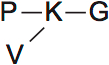
This diagram lets us see, for example, that the percussionist performs before the guitarist.
The final rule is the most complicated rule of the game. First, you must think about the full implications of the rule. It says that the saxophonist is after the trumpeter, or the percussionist, but not both.
The saxophonist can only be before one of the trumpeter or the percussionist. So if the saxophonist is after the percussionist, then the saxophonist is before the trumpeter. And vice versa:
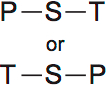
The reverse is also possible. Effectively, the saxophonist has to be between the percussionist and the trumpeter.
You could stop here, but there’s more to deduce. For instance, look what happens if you combine T–S–P with rules 2 and 3:
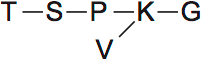
If T–S–P are in that order, we know almost everything. The only uncertainty is where V goes. It could go anywhere earlier than K, including first.
What about P–S–T? We can draw a combined diagram there as well:
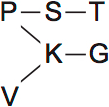
We’re still not done. You always must consider restricted variables. G is very restricted. Let’s see what we know about G:
- G can’t be fourth.
- G has to be after P, K and V
We can combine those to say that G can’t be in the first four spaces. So P, K, V and at least one other band member must be before G. In the diagram above, that means S must be before G:
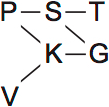
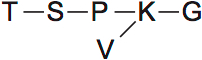
So we have two scenarios. They depend on whether the order is P–S–T or T–S–P:
Scenario 1 (T–S–P)
Scenario 2 (P–S–T)
These diagrams make solving the game lightning fast. If a question asks what “could be true”, you can just check if an answer is possible in either diagram.
Note that you should draw both of these diagrams on the second page, under the questions. That way, it’s faster to refer to the diagrams when solving questions.
Game 1 Main Diagram
These diagrams show the rules used to determine the possible sequence of the solos in a band concert (G, K, P, S, T, V).
Refer to these diagrams when solving this game. Copy them on your own page, and on each question make a new version of them in order to follow along with my explanations. You’ll learn much more if you draw along.
The setup section explains how to build this diagram.
Main Diagram
These are the combined diagrams. They contain every rule. The diagrams will be confusing if you don’t know how to build them. Look back to the setup section to see how to create these diagrams.
Scenario 1 (T–S–P)
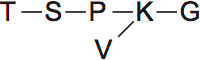
Scenario 2 (P–S–T)
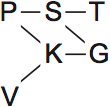
Question 1
For acceptable order questions, go through the rules and use them to eliminate answers one by one.
Note that I use the rules themselves. I don’t use my diagrams for these questions. Reading the rules again for this question will help you memorize the rules, and it’s also more efficient.
Rule 1 eliminates A. The guitarist can’t be fourth.
Rule 2 eliminates D and E. The percussionist has to be before the keyboard player.
Rule 3 eliminates no answers.
Rule 4 eliminates B. The saxophonist has to be between the trumpeter and the percussionist.
C is CORRECT. It violates no rules.
Question 2
In the setup, I showed how all of the rules could be reduced to two diagrams. The diagrams depended on whether the order from the fourth rule was P–S–T or T–S–P.
This question tells us that the percussionist is before the saxophonist, so the order is P–S–T. This diagram is the one that applies:
You can use the diagram to eliminate answers one by one. You’re looking for something that must be true in the diagram, so your goal should be to prove that the wrong answers could be false.
A doesn’t have to be true. The violinist could be before the percussionist. Since neither the violinist nor the percussionist have anyone before them on the diagram, either could go first.
B doesn’t have to be true. The percussionist could be before everyone if we place the violinist after the percussionist.
C doesn’t have to be true. The diagram only places the violinist before the keyboard player. There’s no direct link between these and the saxophonist.
D is CORRECT. You can see this by following the lines on the diagram. P is before G.
E doesn’t have to be true. There are no lines linking the keyboard player and the saxophone player, so either of them could go before the other.
Question 3
This is a “must be false EXCEPT” question. That means the right answer is something that could be true.
Go one by one through the answers and scan both diagrams from the setup. If an answer is possible in either scenario, it’s the right answer. Here are the diagrams again:
Scenario 1 (T–S–P)
Scenario 2 (P–S–T)
A must be false. In both diagrams, the keyboardist is after some other band member.
B must be false. In both diagrams, the guitarist is after at least the percussionist, the keyboardist and the saxophonist.
C must be false. In both diagrams the saxophonist is before the guitarist.
D must be false. In both diagrams the percussionist is before the guitarist.
E is CORRECT. In the P–S–T diagram, the keyboardist could be before the saxophonist. That’s because they have no lines directly connecting them: either could go first. For example, this order obeys the rules:
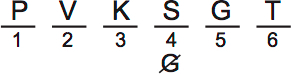
Question 4
This is a CANNOT be true question. For this question, you should think about who is restricted. The question asks who can’t go third, so you should look for a variable that has other variables in front of it.
G is restricted thanks to the second and the third rules. P, K and V all must go in front of G:
So the guitarist always has at least three other players in front. A is CORRECT.
Question 5
This question says the violinist performs the fourth solo. We also know from the rules that the violinist has to be before the keyboardist and the guitarist. So we get this order:
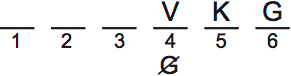
The only players left are P, S and T. We know from rule four that those must be in one of two orders:
- P–S–T
- T–S–P
So we get these two diagrams:
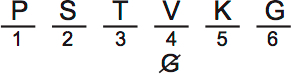
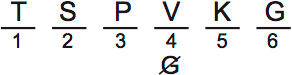
The question is asking for “what must be true EXCEPT”. That means the right answer is something that could be false. Since only P, S and T can be switched, the answer will surely use those variables.
E is CORRECT. The trumpeter doesn’t have to be before the saxophonist. We can see this in the first diagram above.
Game 2: Art Historians
Game 2 Setup
This is an explanation of the second logic game from Section II of LSAT Preptest 74, the December 2014 LSAT.
Four art historians, namely Farley, Garcia, Holden, and Jiang (F, G, H, J) will each give exactly one lecture from four different topics: lithographs, oil paintings, sculptures, and watercolors (L, O, S, W). The lectures will be given in sequence with each art historian giving a lecture on a different topic. You must determine the possible sequence of the lectures and the assignment of topics to speakers.
Game Setup
This is an unusual linear game. It’s unusual because it has two different groups, and some of the ordering rules cross over between groups.
Here’s how to set up the main diagram:
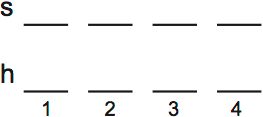
The first rule says that O and W are before L. So far, that’s standard:

It’s the second rule that’s confusing. This rule says that F is before O:

Why is this confusing? Because F is a lecture, and O, W, L are subjects. So F and W could actually be in the same spot, like this:
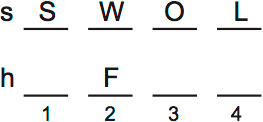
As long as you remember that F and W can go together, this game is easy. Otherwise, it’s hard, and it’s best to draw the O, W, L and F, O rules separately, like this. Then you can check them separately to rule out violations:

If you can handle the ambiguity, it’s cleaner to combine the rules. Just remember that F and W are different types of variables and could go together:
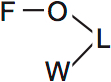
The final rule is about speakers. H is in front of G and J:

Finally, the sculptures lecture is random, it has no rules:

There are a couple of up front deductions. We can say which lecturers go where:
- F has at least two people after it: those that lecture on O and L
- H has at least two people after it: G and J
This means that both F and H can go second at latest. That’s the only way to leave two spaces after them:
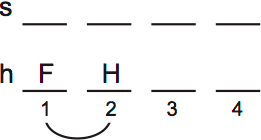
The line under F and H means that the two variables are reversible.
Since F and H go first and second, G and J go must go third and fourth:
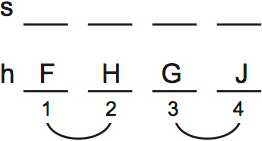
Again, the lines underneath the letters mean they’re interchangeable.
This deduction about FH and GJ makes it much faster to draw diagrams. You should always take some time to examine your setup for small deductions like this before moving on. This is the key to going fast on logic games.
Game 2 Main Diagram
These scenarios show the possible sequence of the lectures (L, O, S, W) and the assignments of the topics to lecturers (F, G, H, J).
Refer to these diagrams when solving this game. Copy them on your own page, and on each question make a new version of them in order to follow along with my explanations. You’ll learn much more if you draw along.
The setup section explains how to build this diagram.
Main Diagram
Rules
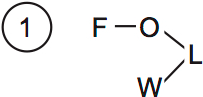
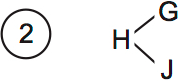

Remember, F is a lecturer, and O, W and L are subjects. So F could be in the same place as W.
In the diagram above, FH must go first and second in either order. GJ must go third and fourth in either order. I explain this deduction in the setup. But briefly, it’s because both F and H each have at least two variables after them.
Question 6
For acceptable order questions, go through the rules and use them to eliminate answers one by one.
Note that I use the rules themselves. I don’t use my diagrams for these questions. Reading the rules again for this question will help you memorize the rules, and it’s also more efficient.
Rule 1 eliminates A. Oil and watercolors are supposed to be before lithographs.
Rule 2 eliminates D. Farley is supposed to lecture before oil paintings.
Rule 3 eliminates C. Holden is supposed to be before Garcia.
Rule 4 eliminates B. Holden is supposed to be before Jiang.
E is CORRECT. It violates no rules.
Question 7
Open ended must be true questions are tricky. Often, they depend on some deduction from the setup. But this game offers no useful setup deductions.
So instead, you should read through each answer and ask: are the variables in this answer restricted, or flexible?
If a variable is flexible, then it’s highly unlikely to be a “must be true” answer, because flexible variables can go in many places.
For instance, A mentioned sculptures. But there are no rules for sculptures. So A is highly unlikely to be correct. This diagram disproves it:
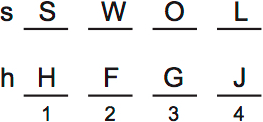
(Under time pressure, you wouldn’t draw that diagram to disprove A. Once you see that S is random, skip the answer to look for a better candidate).
Interchangeable variables are also good candidates for elimination. For instance, G and J are exactly the same. Their only rule is that they’re after H, so they’re interchangeable with each other.
That means C and D are both wrong. Two answers can’t be right, and there’s no difference between G and J.
B is a likely candidate, because it deals with two restricted variables. Both H and L have a lot of restrictions. H must be before two variables, and L is after two variables. That means H can go second at latest, and L can go third at earliest. Here’s an example:
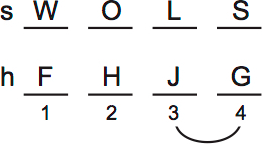
So B is CORRECT, since there’s no way to avoid putting H before L.
I found E difficult to disprove. But since I already was 100% certain B was right, it wasn’t essential to be completely sure E was wrong. Especially since G is an interchangeable variable, and that makes E unlikely to be right.
That said, here’s a diagram to disprove E:
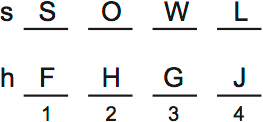
I’ll explain how to make a diagram like this quickly. E says that W has to be before G. So to prove E wrong, we need to see if we can put W later or at the same place as G.
To see if that’s possible, concentrate on W and G separately. Put W as late as possible, and put G as early as possible. Don’t try to think about it in your head: draw it. If you obey the rules, you’ll get the right drawing. That’s what I did above, the diagram clearly shows that E doesn’t have to be true.
Question 8
This question places the watercolors lecture third. Whenever a question gives you a new rule, you should draw it, then ask what deductions you can make using the existing rules.
Here’s W third:
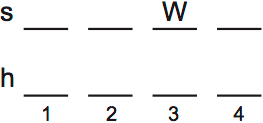
Then, see how this new rule affects the existing rules. W is mentioned in this diagram:
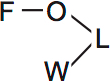
So we need to put L after W. And we also have to put F before O. The only way to do that is like this:
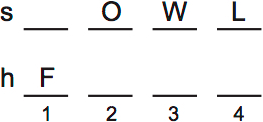
Now we can fill in the remaining variables. S is the only subject left, and it goes first.
The lecturers are H, G and J. The rules say to put H before G and J:
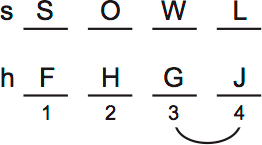
G and J are interchangeable. Since this is a “could be true” question, the right answer will almost certainly involve one of them. Note that the line under G and J indicates they’re reversible.
E is CORRECT. The diagram above shows that it’s possible for J to lecture on lithographs.
Question 9
This is a general cannot be true question. There’s no way to answer it in advance. Instead, you should look through the answers to see which of them involve variables that have a lot of restrictions.
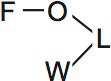
A is CORRECT. This diagram from the rules shows that F has to go before L:
B, C and E are wrong because they involve interchangeable variables (G and J). Since there’s no difference between G and J, they’re highly unlikely to be the right answer on a cannot be true question.
(Technically, it would be possible for an interchangeable variable to be part of the right answer on a must be true/false question, but I’ve never seen it happen. They’re too flexible.)
This diagram proves that D is wrong:
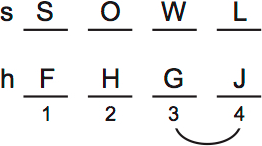
Question 10
In the setup, I explained that G and J must go third and fourth. That’s because both F and H need at least two lecturers after them.
So if G is with S, they must both go third or both go fourth. We can use this to make two scenarios. S and G go third, and J goes fourth, and then vice versa:
Scenario 1
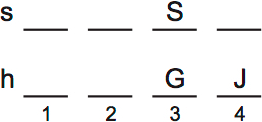
Scenario 2
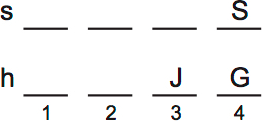
Next, we can fill in the existing rules. F–O–L take up three spaces, so there’s only one way to place them:
Scenario 1
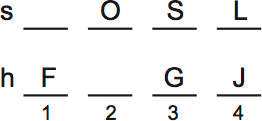
Scenario 2
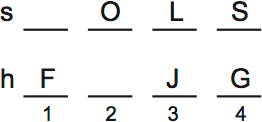
Then, only W and H are left to place, in the only open spaces.
Scenario 1
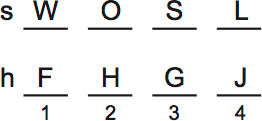
Scenario 2
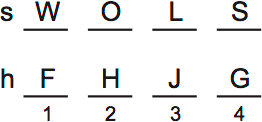
A is CORRECT. In the second diagram, L can be third.
None of the other answers are possible in either diagram.
Game 3: Woven Rugs
Game 3 Setup
This is an explanation of the third logic game from Section II of LSAT Preptest 74, the December 2014 LSAT. Game three involves the following setup:
There are six colors of thread: forest, olive, peach, turquoise, white, and yellow (F, O, P, T, W, Y). Five out of six colors of thread will be use to create three woven rugs. The rugs are either made from a single color or several colors. The rules allow you to determine the possible color composition of the three rugs.
Game Setup
This is a tricky game to explain. It’s not necessarily a hard game to do. That’s because this game depends on your ability to see how the rules combine. There are almost no upfront deductions, and not even a good general template you can make. So my explanations for this are limited because I can’t go inside your mind to show you how to see the game.
This game is a test of your visualization abilities. I am firmly convinced that how you lay diagrams out on your page significantly affects how well and fast you can do games. I do two things:
- My main diagram is on the second page, just under the questions.
- I make new diagrams for each question that requires it.
This significantly reduces eye tracking time. If your diagram is right beside answers, there is no delay between seeing the diagram and judging whether an answer is possible.
Having the main diagram on the second page also helps you reference it faster. I don’t draw anything else in the main diagram area. Having a page free of clutter reduces how hard your brain has to work at understanding the diagram.
There’s one more trick: make things explicit.
For instance, suppose a question places O and P. It’s helpful to then draw a list of who’s left beside the diagram: F, W, T, Y.
Drawing F, W, T, Y seems obvious, and therefore useless. But having the remaining variables visible lets you mentally move them onto the diagram. This removes the need to draw multiple diagrams to test the slight changes.
Ok, enough preamble. Lets see how to draw these rules. I’ll note that there are rules in the setup paragraph too:
- Exactly 5/6 rug colors are used.
- Rug colors aren’t repeated.
The first one is most important. If one color is out, that means all the other colors are in.
Note also that no rug can have more than three colors. The possible color distributions among rugs are as follows:
- 3-1-1
- 2-2-1
Those are the only ways to have three rugs that have a total of five colors.
Ok, the first rule: if white is used, then two other colors are used.

Note that this forces the game into a 3-1-1 color distribution.
Next, if olive is in, then it goes with peach. This leads to a deduction I’ll discuss later:

Rules 3, 4 and 5 say who can’t go together:

This last rule isn’t worth completely memorizing. Instead, have a clear drawing that you can reference in a split-second. Though I did remember that both peach and turquoise were mentioned in two of the exclusion rules.
I mentioned there was a deduction. Deductions come from looking at all of the rules and thinking about how they interact. Deductions also come from past experience on other games. If you know past games well enough, you’ll see similar deductions on new games.
We need five colors. If any one color is out, then all the others are in.
This has a big effect on peach. If olive is out, then peach is in (because all other colors are in). And if olive is in, then peach is in (rule 2).
So either way, peach is always in. This solves question 12 instantly. Surprisingly, this deduction wasn’t useful on any of the other questions.
Game 3 Main Diagram
These diagrams show the rules used to determine the possible color composition of the rugs. The possible colors are: F, O, P, T, W, Y
Refer to these diagrams when solving this game. Copy them on your own page, and on each question make a new version of them in order to follow along with my explanations. You’ll learn much more if you draw along.
The setup section explains how to build this diagram.
Main Diagram
Rules



Question 11
For acceptable order questions, go through the rules and use them to eliminate answers one by one.
Note that I use the rules themselves. I don’t use my diagrams for these questions. Rereading the rules helps you to memorize them, and it’s also more efficient.
Rule 1 eliminates E. White must go with two other colors.
Rule 2 eliminates C. Olive must go with peach.
Rule 3 eliminates D. Forest and turquoise can’t go together.
Rule 5 eliminates B. Peach and yellow can’t go together.
A is CORRECT. It violates no rules.
Question 12
In the setup, I described the following deduction: P has to be in.
Why? We need five colors. If any one color is out, then all the others are in.
This has a big effect on peach. If olive is out, then peach is in (because all other colors are in). And if olive is in, then peach is in (rule 2).
So C is CORRECT. Peach has to be used.
All of the other answers don’t have to be true. This scenario disproves A, B and E:
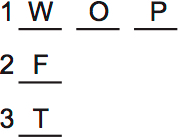
This scenario disproves D:
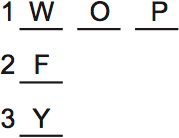
Remember, if something isn’t forbidden, it’s allowed. You should not agonize over whether a hypothetical scenario “works”. If it breaks no rules, it’s allowed.
So it should not take you much time to draw a scenario that doesn’t violate rules, in order to disprove a specific answer. Because anything works if it doesn’t break a rule.
Question 13
This question uses a step by step pattern of deductions to determine almost everything. I’ll show you the eight steps. This is how the LSAT wants you to think.
Step 1: The question says P is alone. So draw that:
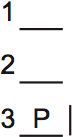
Step 2: Check rules. Notice rule 2 means O is out, since P is alone.
Step 3: Notice that since one variable is out, the others are all in. (Because 5/6 colors are in)
Step 4: Notice this means white is in. Draw it:
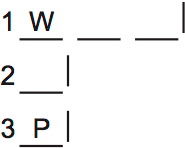
Step 5: List the remaining variables: F, T, Y
Step 6: Notice that the exclusion rules mean that F and T don’t go together.
Step 7: Notice that there are only two groups left. See that this means that F and T are in separate groups:
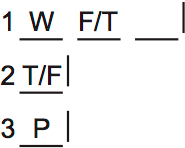
Step 8: Notice that only one space is left for yellow:
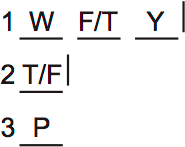
These steps take a lot of text to describe. But if you know the rules, you can move through them in 10-15 seconds. Practice by redoing this game and seeing how fast you can do this question by following the steps.
E is CORRECT. White and yellow must go together in a rug.
Question 14
A solid rug is a rug with only a single color. So if there are two solid rugs, things look like this:
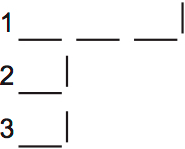
The questions who can’t be the two solid rugs. An open ended question like this can paralyze you. How can you get past paralysis?
You should not sit there, stare at the answers, and try to think of which one is impossible. At least, don’t spend more than five seconds doing this. If the answer isn’t immediately obvious, you will easily waste 30+ seconds if you just stare at the answers. Questions like this aren’t answered in your head. Instead, you can prove answers wrong faster by drawing.
Just draw a working diagram to show the first answer is possible, like this:
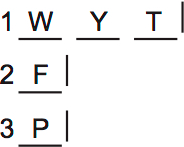
That diagram proves A is wrong. I then used the diagram to disprove the other answers. I looked at the diagram and I swapped around variables in my head. I believe almost anyone can do this, if they know the rules and have a feel for the game.
It’s hard to visualize an entire diagram from scratch (I can’t do it easily). But it’s not hard to move around a couple pieces from a diagram.
For instance, to disprove B, I made the two solo rugs F and Y. That’s close to what I already drew; I just swapped P and Y. So my top diagram was W, P, T instead of W, Y and T.
But then I saw the top group couldn’t be WPT, because PT couldn’t go together. So I visualized the top group as W, O, P instead:
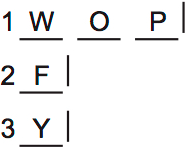
That diagram is valid. Hopefully the process I used to arrive at it made sense. I want to show you how I solve the question, not just make a diagram that explains why B is wrong.
You might feel nervous about trying to visualize new diagrams. Is what you’ve made an ok diagram? Most likely, Yes! This game only has three main rules:
- W goes with two other colors
- If O is in, P is in
- These don’t go together:
FT,PT,FY
As long as you don’t violate one of those rules, then any diagram you draw is valid. Realize this, and you’ll have mastered one of the keys to logic games.
A slight switch from the diagram from A proves that C is wrong. I just looked at that diagram and swapped F and T:
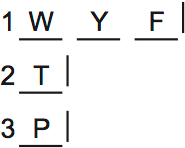
For E, I took the diagram from A and swapped YT with FP:
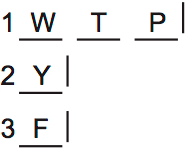
Finally, D is CORRECT. Here’s why it’s impossible. If P and Y are alone, then the remaining options are W, O, F and T.
But, O isn’t an option, because O must go with P. So we would have to place W, F and T in a rug. This doesn’t work, because rule three says that F and T can’t go together.
I encourage you to review this question, and draw my diagram for A on a sheet of paper:
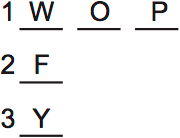
Then mentally move around variables, to practice disproving the other answers in your head, using the aid of a working diagram. Follow the steps I list for each answer.
This method is hard to explain on paper, but once it clicks, you’ll see that it’s very effective.
Question 15
This question says that F and P are used together in a rug. That leaves W, T, O and Y left to place.
The first question is whether the color distribution is 3-1-1 or 2-2-1. (F and P would be together in one of the multi-color rugs)
2-2-1 is pretty hard to do. Of the four remaining variables, only TY could go together. So we could have FP, TY, but….neither W nor O can go alone (rules 1 and 2).
So a 2-2-1 distribution is impossible on this question. Instead, we need a 3-1-1 distribution.
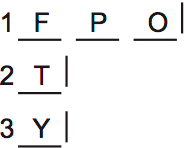
So who can go with F and P? That depends on whether O is in. If O is in, O must go with FP:
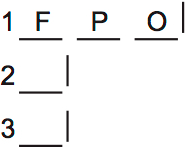
That means W isn’t in, since W must be in a group of three. So T and Y form the solid rugs:
What if O isn’t in? Then all other rugs must be in, so W is included and is in the group of three with FP:
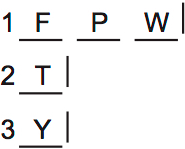
T and Y form the solid rugs, since they’re the only ones left.
B is CORRECT. It’s possible in the first diagram. None of the other answers are possible in either diagram.
Question 16
I had no real method on this question. I simply drew the setup and looked at the first answer. It was correct.
This happens more often than you’d think. The LSAT wants you to panic. If you don’t see any deductions, sometimes there are none, and it’s time to move to the answers.
But set things up well first. Here’s what I drew:
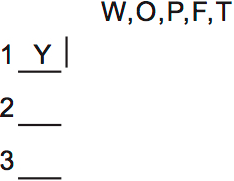
I drew all the remaining variables on top. This lets me quickly see how they interact.
A is CORRECT. It can’t be true that there’s only one solid color rug. If there’s only one solid color rug, then the distribution is 2-2-1.
If the distribution is 2-1-1, then W is out (rule 1). That leave O, P, F and T. OP have to go together (rule 2).
That leaves F and T. And rule 3 says they can’t go together in the remaining rug.
There’s no need to disprove the other answers. Nonetheless, this diagram disproves B, C and E:
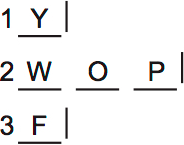
This diagram disproves D:
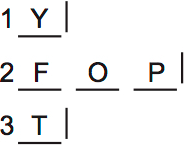
Game 4: Photographers
Game 4 Setup
This is an explanation of the fourth logic game from Section II of LSAT Preptest 74, the December 2014 LSAT.
At least two photographers will be assigned to each of two graduation ceremonies. The graduation ceremonies will be held at Silva and Thorne University (S, T). The six photographers are Frost, Gonzalez, Heideck, Knutson, Lai, and Mays (F, G, H, K, L, M). The rules allow you to determine the possible assignments of the photographers.
Game Setup
This game can be divided into two scenarios that greatly simplify the game. This is a common trend on modern logic games, so be sure you understand this setup.
I recommend drawing the diagrams on a sheet of paper yourself in order to follow along. Ideally, print a fresh copy of the game to use.
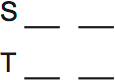
In this game, there are two groups: Silva and Thorne. Each group needs at least two photographers:
FH go together:

Technically this is a linear diagram, but it works just as well for grouping. Using the same symbols in both cases makes for simpler diagrams.
Next, L and M can’t go together:

Next, if G is in S, then L is in T:
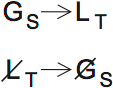
I drew the diagram and its contrapositive in this explanation. On my own sheet, I didn’t draw the contrapositive because I can do it in my head. When you are still learning contrapositives, draw them, but aim to be able to instantly see them in your head.
The next rule is complicated. It says that if K isn’t assigned to T, then H and M must both go in T.
We could leave it at that, but both H and M were mentioned in other rules. F is with H, and L can’t go with M. So the full effect of the rule is this:

There’s still more. If something complicated happens when a rule occurs, follow the idea as far as it goes. It’s best to draw the scenario.
Lets do that. If K isn’t with T, then F, H and M are there:
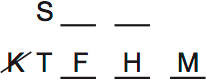
We also know that L isn’t with T, because M is there (rule 2). This affects rule 3: G can’t go with S.
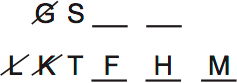
There’s till more. S needs at least two photographers. FHM are already at T. G can’t go to S. So only L and K are left, and they must go to S:
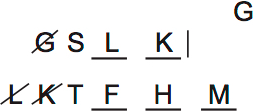
Only G is left uncertain. They could go to T, or they could not be assigned. (Not all photographers have to go somewhere).
So if K isn’t assigned to T, then we know almost everything. The scenario above is the only possible scenario.
Therefore, in all other scenarios, K is assigned to T:
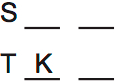
Drawing K there may not seem like a major deduction, but this has two big effects.
- We no longer have to remember the fourth rule. This significantly reduces the difficulty of working with the remaining rules.
- The deduction about K solves question 18 completely, and largely solves 19, 20, and 21.
There are big payoffs for seeing if a game can be split into two scenarios.
Game 4 Main Diagram
These diagrams show the rules used to determine the possible assignments of the photographers (F, G, H, K, L, M) to graduation ceremonies (S, T).
Refer to these diagrams when solving this game. Copy them on your own page, and on each question make a new version of them in order to follow along with my explanations. You’ll learn much more if you draw along.
The setup section explains how to build this diagram.
Main Diagram
There are two scenarios. Either K is with T:
Or K is not with T, and this happens:
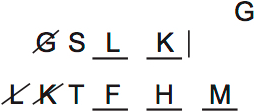
See the setup for how to find the two scenarios.
Rules
Here are the rules. Note that I haven’t drawn the fourth rule, since the two scenarios above account for that rule.


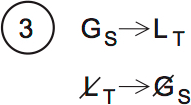
Question 17
For acceptable order questions, go through the rules and use them to eliminate answers one by one.
Note that I use the rules themselves. I don’t use my diagrams for these questions. This helps you memorize the rules, and it’s also more efficient.
Rule 1 eliminates B. F and H must be assigned somewhere, together.
Rule 2 eliminates C. L and M can’t go together.
Rule 3 eliminates A. If G is assigned to S, then L must be assigned to T.
Rule 4 eliminates D. K isn’t assigned to T, so H and M need to be assigned to T.
E is CORRECT. It violates no rules.
Question 18
This question asks what has to be true if H and L are assigned to the same ceremony. The fourth rule completely solves this. In the setup, we saw that if K is not assigned to T, then this happens:
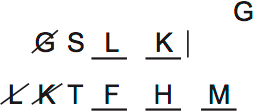
In that scenario, H and L are not together. So that’s not the right scenario for this question. Of course, the only alternative scenario is to put K in T:
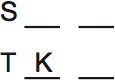
That solves the question. D is CORRECT. K must be assigned to T.
Question 19
This question is similar to the elimination questions that are usually the first questions on games. You can use the rules to eliminate answers.
Note that the answers are listing people assigned to Silva.
Rule 1 eliminates D. H and F must go together.
Rule 4 eliminates A. If K is assigned to S, then they aren’t at T. So H should have been assigned to T.
Rule 4 also eliminates C, in combination with rules 2 and 3. Actually, we saw this in the setup. If K isn’t assigned to T, then G can’t be assigned to S. Because that would force both M and L to be assigned to T, which violates rule 2.
Rule 4 also eliminates E. If K is assigned to S, then M must be assigned to T, not S.
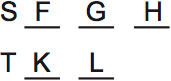
B is CORRECT. This scenario matches B and violates no rules:
Question 20
In the setup, we saw that the fourth rule created two scenarios. This is what happens if K is not assigned to T:
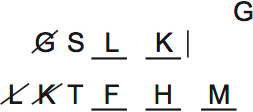
To make another scenario, the only other possibility is to assign K to T:
So K must always be in one of the groups. This eliminates A, D and E, as those answer don’t include K.
Both C and D include FH, as they must, thanks to rule 1. The only difference between the two answers is whether L needs to be included.
This scenario proves that L doesn’t need to be included:
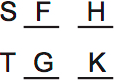
Therefore, B is CORRECT. Only F, H and K need to be included.
Question 21
In the setup, I described how the fourth rule divides the game into two scenarios. Those scenarios make it easier to solve this question, because this question only includes four photographers.
The first scenario showed what happens if K is not assigned to T. That scenario has five people, so it doesn’t work for this question:
So instead we must use the alternate scenario where K is assigned to T:
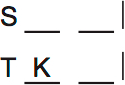
The vertical lines indicate that both groups are full, because this question says only four photographers are included. Each group must have two of the photographers, because the opening paragraph of the setup says so.
Next, think about the rules. The first rule says that FH must be assigned to a group. Only S has two open spaces:
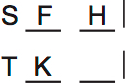
This solves the question. F must be assigned to S, and therefore A is CORRECT.
Question 22
This question asks which list of photographers assigned to Thorne cannot work.
First, remember that if a situation isn’t forbidden, it’s allowed. As long as a scenario doesn’t violate any rules, it’s fine! So you have considerable liberty in making scenarios to test whether answers are possible.
You should also use past scenarios to speed things up. For instance, this scenario from the setup shows that A is possible:
G was the only remaining option in the above scenario, and it’s definitely possible to place G in T.
A was the only answer without K in T. That simplifies the remaining scenarios. As long as K is in T, the game is open ended. You just have to obey these three rules:
- FH together, somewhere.
- LM apart.
- If G is in S, L is in T.
B is CORRECT. To see why, consider who is in S. B places four photographers in T. Each group needs two photographers, so that means only G and L are left to place in S. But rule 3 says that if G is in S, then L is in T.
This scenario proves that C is possible:
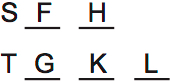
This scenario proves that D is possible:
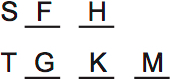
This scenario proves that E is possible:
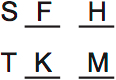
C, D and E are basically the same. The placements in T violates no rules, and you can (and must) legally place FH in S.
Question 23
Rule substitution questions are easier than they seem. There are not many ways the testmakers can create the same effect with a new rule.
Usually, the testmakers will use the secondary effects of a rule. For instance, in this case, rule 1 says that FH are together. So when rule 4 forces H to go into T, really it means that FH must go to T.
This means that you can duplicate the rule’s effect by referring to F instead of H. Only C mentions F.
If you look closely, the effect is the same. Instead of forcing H and M into T, K forces F and M into T if K isn’t assigned to T. Because F and H go together, this new rule forces H into T as well. C is CORRECT.
All of the wrong answers make one of these two mistakes:
- They allow things that aren’t normally allowed.
- They ban things that aren’t normally banned.
Some of the wrong answers are true according to the normal rules. But you’re not looking for what’s true. You’re looking for something to replace the effect of the missing rule.
A is wrong because it allows one of H or M to be assigned to S with K. Normally this can’t happen.
B is wrong because it doesn’t say where F, H and M must go.
D is wrong because it doesn’t force M to be assigned to T if K isn’t assigned to T.
E is wrong because it should have said “unless both H and M are assigned….”

Leave a Reply