
LSAT Preptest 65 LG Explanations
Full explanations for every question from the logic games section of LSAT Preptest 65.
Archived Logic Games explanations
Logic Games are no longer part of the LSAT. LSAC removed the Logic Games section beginning with the August 2024 LSAT. If you are studying for the current LSAT, you can skip this section.
These explanations remain available for students, tutors, and readers using old-format PrepTests. For current guidance, see Logic Games and the current LSAT.
Table of contents
Game 1: Piano Recitals
Game 1 Setup
This is an explanation of the first logic game from Section II of LSAT Preptest 65, the December 2011 LSAT.
Five students will perform in a piano recital. They are Fernando, Ginny, Hakim, Juanita, and Kevin (F, G, H, J, K). Each student will perform one piece and no two performances can overlap. You need to decide the order of their performances.
Game Setup
The setup of this game is quite simple. However, the questions make up for it. A few of the later questions are harder than normal, for a pure sequencing game.
Ok, time to make a diagram. You should always read the rules before drawing, it lets you make additional deductions.
For instance we can combine rules 1 and 3. G is before HF, which are in either order. The box with a line over it indicates HF can be reversed:

Secondly, K is before both HF and J. You can combine all three rules in one diagram:
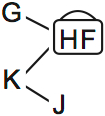
That’s it. Of course, it’s important to know how to read this diagram.
J could go before G, for example. Even though J is to the right of G on the diagram, there’s no line connecting them.
The only rule for J is that it goes after K.
Draw a few sample orders and refer to the original rules if you’re still unfamiliar with how to read sequencing diagrams. It should become second nature to make correct scenarios.
Hint: there are LOTS of different ways to make a correct scenario. Any scenario that doesn’t violate a rule is 100% fine.
Game 1 Main Diagram
These diagrams show the rules used to determine the proper order of the student performances (F, G, H, J, K) at the piano recital.
Refer to these diagrams when solving this game. Copy them on your own page, and on each question make a new version of them in order to follow along with my explanations. You’ll learn much more if you draw along.
The setup section explains how to build this diagram.
Main Diagram
Remember that K or G could be first, and that G could go before or after J.
J or HF could be last.
Question 1
For list questions, go through the rules and use them to eliminate answers one by one.
Rule 1 eliminates E. G must be earlier than F.
Rule 2 eliminates A and B. K has to be earlier than H and J.
Rule 3 eliminates C. H must be beside F.
D is CORRECT. It violates no rules.
Question 2
It’s helpful to make a new diagram when a question gives you a new rule. Just put G after J, and copy the other rules from the main diagram:

A is CORRECT. F can go fourth or fifth. All the other answers are impossible.
Question 3
You’re looking for something that can’t be true.
This question tests whether you combined the third rule with the other rules. If you did that, then you know H has to come after G and K.
C is CORRECT.
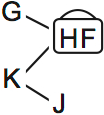
I’m not drawing scenarios to prove all the other answers correct, as you’ll benefit more from trying them yourself. But here’s proof that A is possible, for example:

The general rule is that if something isn’t explicitly forbidden by the rules, it’s allowed. So this diagram would also work to disprove A:

F is fourth in both diagrams. Neither is better than the other, they’re both perfectly good proofs that A is possible and therefore wrong.
For all the wrong answers on this question there are many scenarios that disprove them.
Any drawing you make that doesn’t violate one of the rules from the setup is a valid drawing. It’s good practice to make them for all answers, quickly, when reviewing.
Question 4
Main Diagram
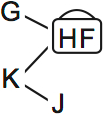
Here’s where the questions start to get trickier. This questions asks us what would ‘fully determine’ the order of the students.
The big wildcard in this game is HF. Those two variables can go in either order. So the right answer has to lock down their order.
Unfortunately, that insight doesn’t help here. All the answers include H or F.
But there are other variables, and there are no rules that tell us the order of G and K, or G and J. So you need to settle that.
This is important, so I’ll repeat it. The correct answer must lock down the relative order of G, K and J. If an answer leaves some uncertainty about where they go, it’s wrong.
A doesn’t work, because it doesn’t affect G, K or J.
B is a poor candidate, because we already knew G was before HF.
C is a bit better. It tells us the order of FHJ. But it doesn’t tell us the order of G and K. Either could be first.
D is also partly successful. It tells us the order ends with JHF. But it doesn’t affect the order of G and K. Either could go first.
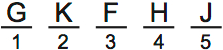
E is CORRECT. The answer tells us that KFH go in a row. We still have to place G and J.
G must go before F, so we get GKFH. And J must go after K. So we get this order:
Question 5
Main Diagram
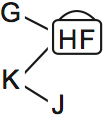
This question is a bit tricky. I almost got it wrong, because I mistakenly thought J could go fourth.
First, it’s obvious H and F can each go fourth. We’ve seen many scenarios that put them there.
Here’s one, just for proof. Remember that HF are reversible, so either could go fourth in this scenario:
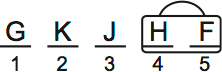
So at least two students can go fourth: H and F.
G and K can’t go fourth, because they’re stuck earlier than HF. G and K can go third at the latest.
That leaves only J as a candidate.
The problem with putting J fourth is that it leaves no open spaces for HF to go beside each other. Have a look. Both G and K need to go before HF:
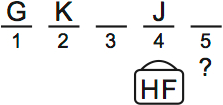
J leaves no space for HF. And if you put HF earlier than third, then there would be no way to put G and K in front of HF.
So B is CORRECT. Only H and F can go fourth.
Game 2: Open House
Game 2 Setup
This is an explanation of the second logic game from Section II of LSAT Preptest 65, the December 2011 LSAT.
Six consecutive presentations on six different subjects will be given at an open house. Jiang will present needlework and origami (N, O), Kudrow will present pottery, stenciling and textile making (P, S, T) and Lanning will present woodworking (W). You need to use the rules to determine what order they can present in.
Game Setup
This is a linear game. It’s less complicated than it looks.
My central theory for logic games is that success depends on figuring out how to make a complicated situation less complex.
Our brains can’t handle more than about 7 facts at the same time, and the more facts we have to keep track of, the worse we do. So every rule you simplify improves your effectiveness.
For instance, the game lists three teachers, so you might think they’re an important part of the game.
They aren’t. Instead, the six presentations are all you have to worry about.
So you could draw this list of teachers, but I don’t find it helpful.
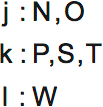
Exactly one question asked about a teacher (question 9), and you can just look back to the rules to see what classes that teacher teaches.
The first rule does involve a teacher, but we can turn this into a rule about the presentation.
The rule says K can’t give two presentations in a row. What this really means is that P, S and T can’t be beside each other. Here’s how I drew it:

If you studied Powerscore, you’ll have seen this diagram, and you’ll recognize that I’m using it the wrong way. Technically, in the Powerscore system, this diagram means that PST can’t form a group of three.
Who cares? I’m giving the diagram a new meaning for this game. I know the context of the game. Only the first rule keeps people apart. So I read my diagram as meaning you can’t have PS, SP, PT, TS, etc.
The traditional way to draw this rule would be like this:

I personally find this diagram hard to read quickly. On logic games I care most of all about being right AND fast.
You should be copying this diagram on the page as you follow along with these explanations. Use whichever method makes more sense to you.
Rule 2:

Rule 3:

This game only has six spaces. That’s pretty restrictive. Here’s the setup:
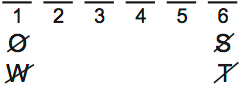
I’ve added in the deductions from the first and second rule.
We’ve drawn all the rules. But before starting a game, you should always see if a logic game has a particularly restricted point. Here, P, S and T are very restricted. Especially S and T.
You always have to space PST apart from each other. You’ll get diagrams that look like this. The X’s represent PST in any order:
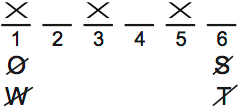
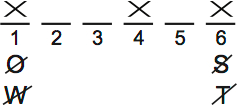
There are too many possibilities to bother drawing each one, but you should be aware that whenever you place one of PST, the others may be forced into specific spots.
Especially if there is no PST in spot 1 or 6. PST take up 5 spaces at minimum. The first diagram with the X’s is an example of this.
I said S and T are particularly restricted. This is because they are affected by other rules. Their order is S – O and T – W.
So out of PST, P tends to have to go last. If P goes before S and T, there often isn’t enough space to put S – O and T – W. A couple of questions test this deduction.
Game 2 Main Diagram
These diagrams show the rules used to determine the order of the presentations (N, O, P, S, T, W) by the teachers at the open house.
Refer to these diagrams when solving this game. Copy them on your own page, and on each question make a new version of them in order to follow along with my explanations. You’ll learn much more if you draw along. The setup section explains how to build this diagram.
Main Diagram
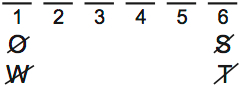
Rules



Question 6
For list questions, go through the rules and use them to eliminate answers one by one.
Rule 1 eliminates A and E. PST can’t be together.
Rule 2 eliminates D. S must be earlier than O.
Rule 3 eliminates B. T must be earlier than W.
C is CORRECT. It violates no rules.
Question 7
When a question gives you a new rule, draw a new diagram and ask how the new rule affects existing rules.
The question places T fifth. We know that T is before W (rule 3):
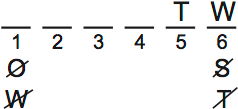
Next, T can’t be beside P or S (rule 1).
PST need five spaces to spread out. Since T is fifth, then P/S must go first and third.
Whenever there’s only two possibilities, it’s helpful to draw both. It should only take you a few seconds to draw these two diagrams:
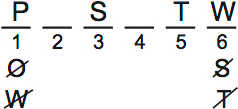
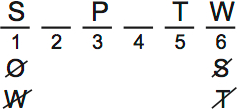
Now you can make separate deductions on each diagram. For instance, you know O is after S:
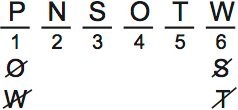
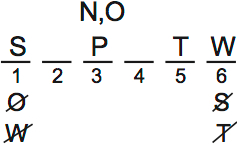
In the second diagram, N and O go in either order.
D is CORRECT. S can go third or first.
It turns out we solved a bit more than we needed, but it’s always helpful to practice the process of making deductions.
Alternate Method – Elimination
You could also solve this question by elimination.
A is wrong because W has to go sixth, so N can’t go there.
B is wrong because P can’t go beside T, and T is fifth.
E is wrong because W has to go after T, so W is sixth.
Elimination is a very effective method. Now we’re down to two answers, D and C.
To solve the question at this point, you would just try a couple of diagrams to see whether S can go second, or third.
Question 8
This question places N first. Remember that PST need five spaces. If N is first, then PST must go in spaces 2, 4 and 6, represented by X’s:
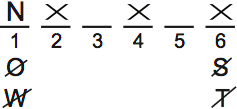
S and T can’t go last, due to rules 2 and 3. So P goes last, and ST go in 2 and 4, in either order. We can draw two diagrams to capture both possibilities:
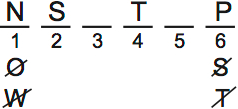
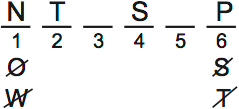
Next, apply rules 2 and 3 (T-W and S-O) In the first diagram, W must go in spot 5, after T.
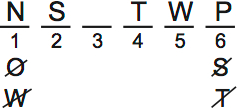
In the second diagram, O must go in spot 5, after S.
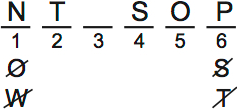
That leaves space 5 open for the remaining variable. In the first diagram, O goes in space 3, and in the second diagram, W goes in space 3.
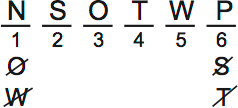
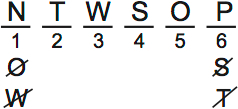
If that was confusing, draw the diagrams yourself and you should see how it works. Another way of looking at it is that TW and SO are interchangeable, in spaces 2-3 and 4-5.
E is CORRECT. Woodworking can be third.
Question 9
This is the only question that references one of the teachers: Jiang. We know they present N and O. So you can read this question as asking which two spaces can’t be filled by N and O.
I solved this question by drawing each answer. Sometimes there’s no other method, so you should practice getting fast at making correct diagrams.
You should try making diagrams to disprove the answers yourself, now, before looking at mine.
Any diagram that follows the rules will disprove an answer, if the diagram has NO in the right places.
O is important, remember that O comes after S. That means O can’t go first. So for answers A-C, you’d have to put N first and O in the other spot.
The other rules are that PST are spread out, and T goes before W.
This diagram disproves A:
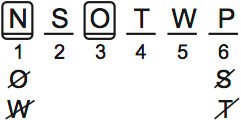
This diagram disproves C:
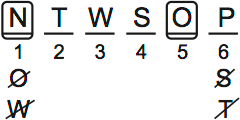
This diagram disproves D:
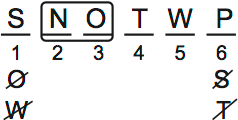
This diagram disproves E:
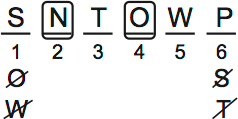
B is CORRECT. If you put NO in one and four, there’s no place to put PST without putting them together:
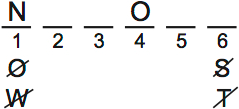
You’d be forced to put two of PST together in 2-3 or 4-5.
Question 10
If N is 6th, then there are only five spaces left for PST. Since these letters must be kept apart, their positions looks like this:
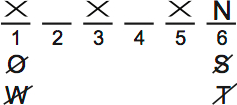
We can deduce a bit more. Rules 2 and 3 say that both S and T need a variable after them (S-O and T-W). So neither S nor T can go fifth.
Therefore P must go fifth.
Once again there are two possibilities. Either S is first and T is third, or the opposite:
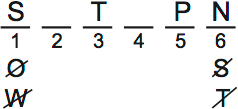
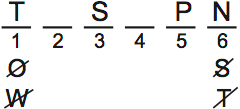
Next, apply rules 2 and 3. The 4th spot is the limiting spot in both cases.
In the first diagram, W must go 4th to be after T.
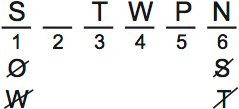
In the second diagram, O must go 4th to be after S.
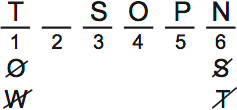
There’s only one spot left in each diagram, so put the other variables there. In the first diagram, O goes second:
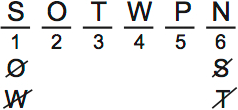
In the second diagram, W goes second:
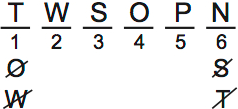
Once again, I’ve shown more deductions than we needed. We could have stopped with the very first deduction: P is 5th. B is CORRECT.
However, you never know which deduction will be tested. So it’s valuable to practice making all of them. Usually it doesn’t take long to add the extra deductions.
Question 11
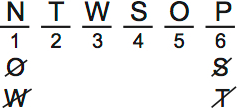
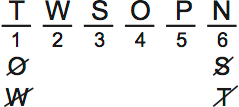
It’s helpful to use scenarios from past diagrams to disprove answers.
This scenario from question 9 disproves A:
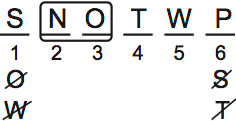
The correct answer to question 6 disproves B.
This scenario from question 8 disproves D:
This scenario from question 10 disproves E:
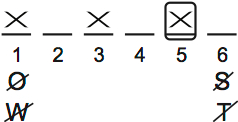
C is CORRECT. PST are pretty restricted. Placing one of them fifth creates this order:
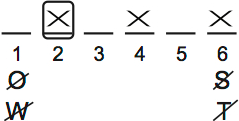
Placing one of PST second creates this order:
This is the central point of the game. PST need at least five spaces. If you’re still unsure about how this works, you should redo this game in a day or two, and keep redoing it until this makes sense.
So, C doesn’t work because if you place P 2nd, then S and T must go 4th and 6th.
Except, S and T can’t go 6th. They both need another workshop after them. Therefore P can’t go 2nd.
Game 3: Luncheon
Game 3 Setup
This is an explanation of the third logic game from Section II of LSAT Preptest 65, the December 2011 LSAT.
A luncheon organizer will serve five foods from a selection of eight. The eight foods are: two desserts (F, G), three main courses (N, O, P) and three side dishes (T, V, W). Three of the eight are hot foods (F, N, T).
Game Setup
This is a grouping game. You need a firm grasp of the rules to solve this game. Make sure you’ve reread them before reading this explanation.
I set this game up using an in-out diagram (drawn later). I usually don’t use this type of diagram, but for this game I found it extremely useful to be able to show which variables are out.
This is because the game often places three variables out, which means that all the other variables are in.
There are two things I want to point out. First, it’s fine to modify your diagramming style based on circumstances.
Second, you don’t have to do games perfectly. I didn’t use an in-out diagram when I first did this game. I got everything right, but I struggled.
When I sat down to explain it, I realized an in-out diagram would be much simpler.
So my original diagram wasn’t the same as my final diagram. You might ask: why bother studying these final diagrams then?
Well, even though I didn’t draw an in-out diagram, I was very aware of which variables are out. That comes with practice, and from having drawn ‘out’ diagrams on previous games.
So by practicing with the best diagrams, you’ll stand a better shot of coming up with great diagrams when you see new games. And even if you don’t get the ideal diagram, your intuition will be better for having studied ideal diagrams.
Ok, on to the rules. There are eight foods, and five of them are included. Take note whenever a game includes only some of the variables. We know, for instance, that if three variables are left out, then the other five must be in. This comes up a lot in this game.
The dishes are desserts, main courses, and sides. Some are hot. Here’s the list. I indicated the hot foods by putting a box around them.
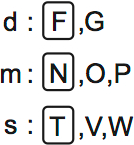
You could draw a separate list of hot foods, but it’s best to stick to the smallest possible number of diagrams. That makes it easier to see the whole setup.
Here’s the in/out diagram I mentioned earlier. I included the first rule directly on it. That rule says that at least one dessert, main course and side dish are in:
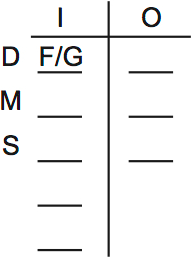
I included one slot for dessert, main course, and side dishes. Note that these only refer to the in group. The out group can be any type of dish.
There are only two desserts: F and G. So at least one of F and G is in. I drew that on the diagram.
Rule two I just memorized: it says you always need at least one hot food. You could draw ‘1+ Hot’ in your list of rules if you prefer.
Rule three says either PW are both in, or both out:

Rule four says that if G is in, O is in:

Rule five says that if N is in, V is out:

If you’re still making mistakes or forgetting contrapositives, you should draw the contrapositives for rules four and five. Otherwise it’s not necessary. Here are the contrapositives:


Rule five is important. One of N or V is always out. This type of rule comes up again and again on logic games.
N and V could both be out together, mind you. The rule doesn’t say ‘if N is out, V is in’.
But at least one always has to be out. You can put this deduction on the main diagram:
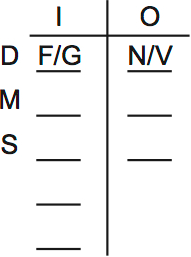
We could stop here. But there’s one more deduction which is somewhat useful.
It has to do with the third rule. PW are either in or out. When the game gives you only two possibilities, you should try both of them. This usually leads to deductions.
Not much happens if we put PW in. Still, this lets us view the scenario more clearly.:
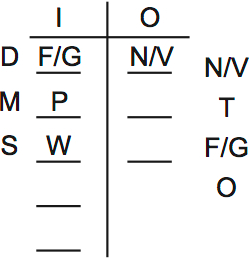
I drew the remaining variables to the right of the diagram. It’s much easier to visualize combinations when the open slots and remaining variables are written down in front of you.
Note that I put P and W in the M and S slots. This makes it clear that rule one is fulfilled in this scenario.
Now, if we put PW out, then three variables are out: P, W, and one of N/V.
That means everyone else is in!
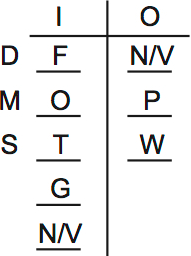
So if PW are out, then the only uncertainty is which of N or V is in.
I actually don’t use these scenarios very much in the explanations. But I’m definitely aware of them, and you should be too.
Studying these deductions upfront is worthwhile. Sometimes you’ll get them, and even if you don’t your intuition will be better.
Game 3 Main Diagram
These diagrams show the rules used to determine which foods (F, G, N, O, P, T, V, W, F, N, T) that can be served at the luncheon.
Refer to these diagrams when solving this game. Copy them on your own page, and on each question make a new version of them in order to follow along with my explanations. You’ll learn much more if you draw along.
The setup section explains how to build this diagram.
Main Diagram
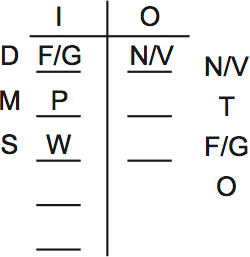
Rules


I didn’t draw one rule. The second rule says that there’s always at least one hot food: F, N or T.
Some rules are hard to draw, and I find it easier to memorize them.
Question 12
For list questions, go through the rules and use them to eliminate answers one by one.
Rule 2 eliminates E. We need at least one hot food.
Rule 3 eliminates D. P can’t be in the in group without W.
Rule 4 eliminates C. G needs O.
Rule 5 eliminates A. N and V can’t be together.
B is CORRECT. It violates no rules.
Question 13
I skipped this question the first time I did the game. I hoped later questions would give me scenarios that I could use to eliminate answers.
That didn’t end up helping much. So I came back and make scenarios to disprove wrong answer. Fortunately, with practice, you can learn to make correct scenarios quite quickly.
Try to disprove the wrong answers on your own first before you check my scenarios. Aim to do it correctly, and fast. If it feels slow, redo it until it’s quick and second nature.
This scenario eliminates A:
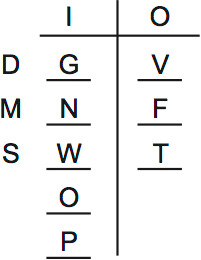
This scenario eliminates B:
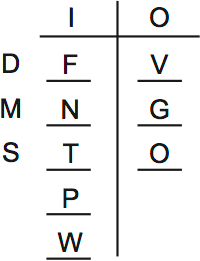
This scenarios eliminates C:
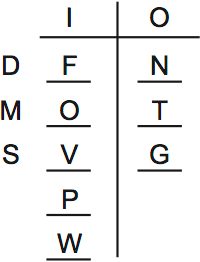
The second scenario from the setup eliminates E. V can be out with W, since either N or V could be out:
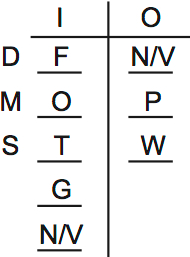
D is CORRECT. It says P and O are out. You also have to put one of N/V out. That’s three variables.
But then you have to put W out, because PW are always in or out together. So P, O, W and one of N/V are out. You also have to put G out because the rules tell us that if G is in, O is in, and by way of the contrapositive we know that if O is out, G must be out.
That’s five variables out, which is too many. A maximum of three variables can be out.
Question 14
Whenever a question gives you a new rule, you should draw a new diagram that uses that rule.
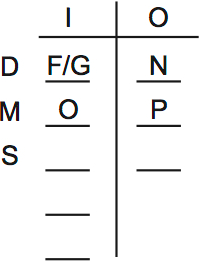
O is the only main course. That means the other main courses are out (N and P):
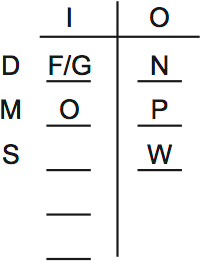
Since P is out, W must be out too (rule 3):
All three out spaces are full. That means every other variable is in:
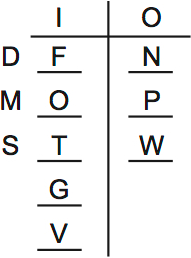
Once again, we’ve done too much work. But I wanted to walk you through all the deductions that are possible.
Since P is out, W can’t be selected. E is CORRECT.
A small note on how to fill in the final diagram. It’s helpful to have a default way to fill in variables, so you don’t get stuck wondering who goes where.
If I’m filling in the listed D, M and S spots, I just go with the hot foods, F, N and T. There’s no reason not to put them there.
So if I’m trying to build a scenario, I will fill it with F, N and T unless there is some reason to use other variables.
In this case, I did F, O and T because the question told us to put in O for the main course.
This meant that when filling in all five variables, I automatically filled in F and T. Then I stopped to consider which variables remained, and filled in G and V.
With a default order to fill things in, you can create diagrams much faster. Obviously, your default order must obey all the rules.
Question 15
If we don’t have F, then we have G, since at least one dessert must be in. That means we have O as well:
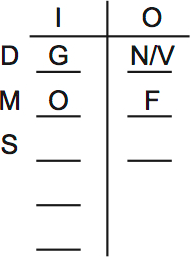
The next step may not be obvious. PW must be in or out. That requires two spaces. There’s only one space in the out column.
So PW have to be in:
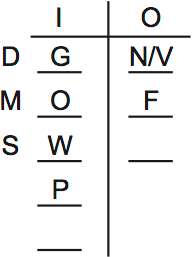
Finally, we need a hot food (rule 2). The hot foods are F, N and T.
F is already out, so one of N or T is selected. That means V has to be out, because there’s no space left:
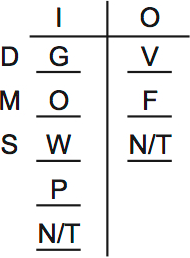
So we can figure almost everything out, based on the local rule!
A is wrong because both P and O must be selected.
B is wrong because W must be selected.
C is wrong because there’s only room for one hot food. It’s one of N/T.
D is CORRECT. We could place N in, and T out:
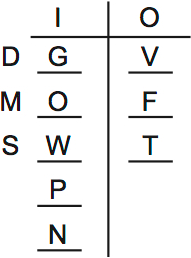
E is wrong because V is always out for this question.
Question 16
If T and V are in, then W is out. So P is out.
Sound familiar? This is the second scenario from the setup. N, P and W are out, so everything else is in:
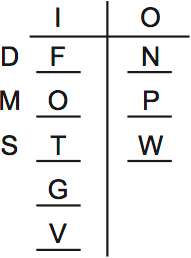
A is CORRECT.
Game 4: TV Programming
Game 4 Setup
This is an explanation of the fourth logic game from Section II of LSAT Preptest 65, the December 2011 LSAT.
Five television programs will be shown in a three-hour block. One is an hour-long program called Generations (G) and the other four are half-hour programs: Roamin’, Sundown, Terry, and Waterloo (R, S, T, W). Each of the programs will be shown once, one after the other. You must use the rules to determine the possible orders of the programs.
Game Setup
This is a linear game, with a slight twist. The six slots include hours and half hours. You must keep track of which variables can start on the hour, and which ones start on the half hour.
One of the variables, G, is an hour long. I kept track of this by drawing it GG. But, you have to remember that GG = 1 variable. Some questions require you to count the number of variables.
Here’s my variable list:

Here’s the main diagram:

The first rule says that GG can only start on the hour. There’s no great way to draw this rule. Better just to memorize it. I’ll add it to the main diagram later, which is another way not to forget. But if you do want to draw a way to list the rule, just make something up, like this:

You can do the same for rule 2. I do prefer to memorize it and/or put these rules on the main diagram. But here’s a plausible way to draw the second rule:

Rule 3 says R is before S:

Rule 4 says that either W is directly before T, or T is somewhere before W:

A couple questions require you to remember this rule. Hint: if W is first, then it’s definitely before T.
I like to put rules 1 and 2 directly on the main diagram:
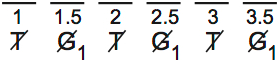
The G’s are labelled G1, as a reminder that it’s just the first G that can’t go on the half hour.
Honestly, it’s probably better just to memorize those two rules. It’s not hard. Just read them a few times each, and remember that there are two rules that deal with hours and half-hours.
I’m keeping the ‘not’ rules under the main diagram for the rest of these explanations. Not everyone reading these will memorize the rules, so that will make the diagrams clearer for them.
But if you’re serious about doing well, I recommend practicing simply memorizing these rules. It’s not hard to memorize 1-2 key rules on each game, and you go so much faster when you do. Your diagrams will also be simpler and quicker to draw.
Game 4 Main Diagram
These diagrams show the rules used to determine the possible orders of the television programs (G, R, S, T, W).
Refer to these diagrams when solving this game. Copy them on your own page, and on each question make a new version of them in order to follow along with my explanations. You’ll learn much more if you draw along.
The setup section explains how to build this diagram.
Main Diagram
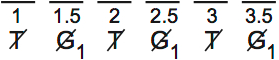
Rules

I’ve drawn rules 1-2 directly on the diagram. G must start on the hour, and T goes on the half hour.
It’s also a very good idea just to memorize them, as you can make new diagrams much faster, with fewer mistakes.
Question 17
For list questions, go through the rules and use them to eliminate answers one by one.
Rule 1 eliminates C. GG can’t start on the half hour.
I did find it hard to eliminate this answer. I solved it by counting R, T, W as 1.0, 1.5, and 2.0. I then realized that GG starts on 2.5, which doesn’t work.
Rule 2 eliminates A. T has to start on the half-hour. I had the same difficulty eliminating this answer as I did with C. I got around it by counting.
Rule 3 eliminates E. R has to go before S.
Rule 4 eliminates D. If W is before T, then W has to be immediately before T.
B is CORRECT. It violates no rules.
Question 18
When a question gives you a new rule, you should draw it.
We know that if W is before T, then W has to go immediately before T.
If W is first, then it’s definitely before T. So the diagram starts like this:
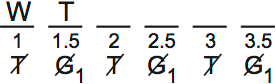
Now, we need to know how many orders are possible. It’s probably a small number.
Best to start by placing a restricted variable. GG can only go on the hour. So there are only two possibilities:
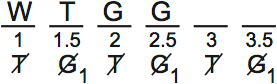
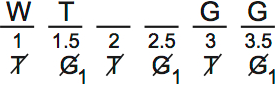
Only R and S are left. We know R goes before S (rule 3). So there are only two possibilities:
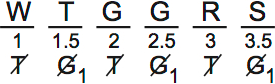
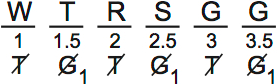
B is CORRECT.
Question 19
This question places R second. You should always look at restricted spots. If R is second, then there is exactly one program before R. Which program could it be?
Not T. T can’t start on the hour.
Not W. If W goes before R, then W is also before T. But the fourth rules says that T has to come right after W is W is before T.
Not S. S has to go after R.
So only GG can go before R. This means R is in the third slot (but they are still the second variable). Remember that GG only counts as one variable:
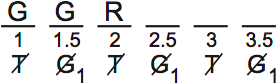
T, W and S are left to place. S can go anywhere, since it’s automatically after R. So let’s focus on T and W.
T can only go on the half hour. So T can go fourth or sixth. If T is fourth, W and S can go in either order:
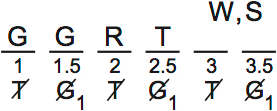
If T is sixth, then W must go immediately before T (rule 4). S is left to go fourth:
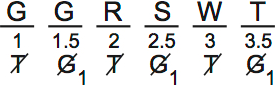
D is CORRECT. There is no way to put W third.
All of other answers are possible, on one of the two diagrams.
Question 20
There are two possibilities, if S is third. Either S is in the 3rd slot:
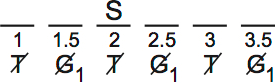
Or S is in the 4th slot, but is the third program, because GG comes earlier. GG would have to go first:
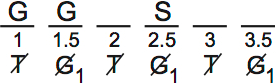
Let’s try to complete the first diagram.
We know R has to go before S. And in this diagram, GG has to go at 3 o’clock, because it’s the only open spot left that is on the hour:
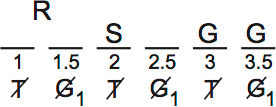
T and W are left. There aren’t two open spaces to place WT, so T must go somewhere before W instead (rule 4):
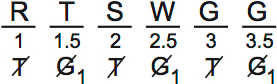
R goes first and T goes second because T must go on the half hour.
Let’s try to fill out the second diagram, where GG goes first and S goes in the fourth slot.
We know R goes before S:
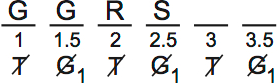
Only T and W are left. T has to go on the half hour, so we get this order:
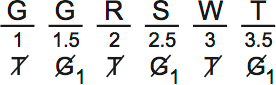
In both diagrams, W is fourth. E is CORRECT.
The other answers don’t have to be true. At least one diagram shows that each of the other answers could be false.
Question 21
If GG is the third program, then it must be in the third spot, at 2 o’clock:
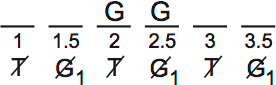
T is the next most restricted variable. T can only go on the half hour. So T can go second or last:
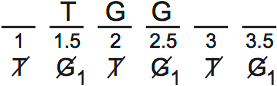
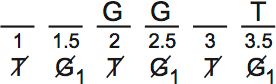
If T is second, there are two main possibilities. Either W is first, and RS are last. Or R is first, and WS are last in either order:
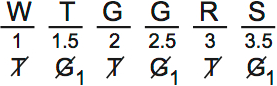
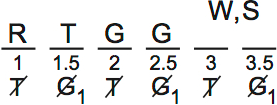
Both scenarios obey the fourth rule: W is either directly in front of T, or W is somewhere after T. Both diagrams also put R before S.
Let’s look at the second diagram from above, where T is last. There is only one possibility. W must go fifth, directly before T, and RS must go first and second. (rules 3 and 4):
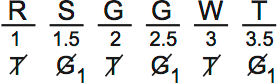
C is CORRECT. S could be the fourth program in this diagram, since W and S are reversible. Remember that GG is just one program:
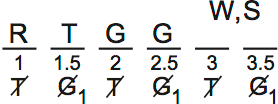
None of the other answers are possible.
Question 22
You can use past questions to eliminate answers on many must be true or must be false questions.
Any scenario that worked on a previous question is something that could be true.
This scenario from question 21 eliminates A:
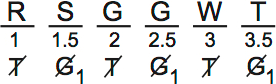
This scenario from question 20 eliminates D:
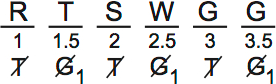
This diagram from question 19 shows that E is possible. W could be at 3 o’clock:
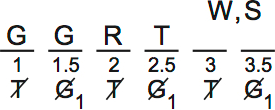
That leaves B and C. This scenario eliminates C:
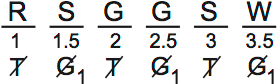
B is CORRECT. There’s no way to put W right before R without placing T on an hourly slot, or breaking the rule about W coming immediately before T.
Try drawing it, and you’ll see it can’t be done. There’s no good drawing I can make to show you, because you’d only think this answer works if you’re forgetting a rule. I don’t know which rule you’re forgetting.
If you draw it yourself and refer carefully to the rules, you’ll learn it better anyway.
Question 23
For rule substitution questions, you should consider the full effect of the rule in question. Usually the right answer is just a rephrasing of the rule’s effects.
If GG can only go on the hours, then that means GG can’t go on the half hours.
So GG can’t start 2nd or 4th. C is CORRECT.
You might have noticed there’s another half hour slot: 6th. This rule doesn’t say GG can’t go there. So how is this a complete answer?
Well, we don’t need the first rule to tell us that GG can’t start 6th. Since there are two G’s, they couldn’t start on the last spot. There’s be no place to put both G’s.
A is wrong because it would allow GG to start on the half hour as long as T was elsewhere.
B is wrong because it is too restrictive. GG should also be able to start 3rd.
D is just weird. It has nothing to do with the original rule. Normally putting G third doesn’t affect R.
E also makes little sense. Avoid answers that introduce conditionals that weren’t obviously part of the original rules.

Leave a Reply