
LR Question 16 Explanation
QUESTION TEXT: All etching tools are either pin-tipped or bladed…
QUESTION TYPE: Sufficient Assumption
CONCLUSION: More etching tools are used for engraving than are not used for engraving.
REASONING: All pin tipped tools are used for engraving. Some bladed tools are used for engraving and some are not. All etching tools are pin tipped or bladed.
Note: This situation may be confusing. I’ve drawn a diagram to illustrate this question. The key to this question is we don’t know how many bladed tools are used for engraving and how many aren’t:
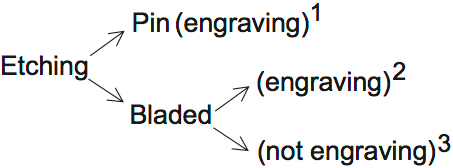
So category 3 (bladed, not engraving) could be enormous. Way bigger than categories 1 + 2.
ANALYSIS: This argument ignores quantities. There could be three types of pin tipped tool, and 3,000,000 types of bladed tools. And maybe only 2 bladed tools are used for engraving. That would mean 5 tools are used for engraving and 2,999,998 are not.
We need to eliminate this possibility. For instance, by saying there are equal numbers of pin tipped and bladed tools, or more pin tipped tools.
___________
- This tells us that there are no chiseling tools used for engraving (for example). And no hammering tools used for engraving. So what? The conclusion is only about etching tools. Etching tools are only pin tipped or bladed
- CORRECT. This equalized the numbers of both tools. It makes it mathematically certain that most etching tools are used for engraving. Let’s say there are 8 pin tipped tools and 8 bladed tools. Then at least nine would be used for engraving: 8 pin tipped, and at least one bladed.
- This answer isn’t a sufficient assumption. It just tells us a useless fact about pin tipped and bladed tools. Look at my example in the analysis section. I was already assuming the two categories didn’t overlap, yet the conclusion wasn’t true in my example.
- This weakens the argument! We want to prove that etching tools are used for engraving.
- We actually already knew this. Pin tipped tools are all used for engraving, and pin tipped tools are the only etching tools that aren’t bladed.
Recap: The question begins with “All etching tools are either pin-tipped”. It is a Sufficient Assumption question. To practice more Sufficient Assumption questions, have a look at the LSAT Questions by Type page.
More Resources for Sufficient Assumption Questions
- Conditional Reasoning Article: Learn about conditional statements.
- LR Diagrams Guide: Learn how to draw LR diagrams.
- Intro to Conditional Reasoning: Learn conditional reasoning basics.
- Intro Course lesson: This intro course lesson covers Sufficient Assumption questions.
- Mastery Seminar lesson: This LR Mastery seminar lesson covers sufficient assumption questions.

I chose B, but based on the explanation above, I’m still not grasping why D is a weakening answer choice. I see that it doesn’t fill the gap to allow our conclusion to be drawn, but how does it weaken?
If the majority of bladed etching tools are not used for engraving, we still have no idea if that’s larger or smaller than the supply of pin-tipped tools. I was thinking that it’s more of a neutral effect, or just something that we don’t know enough about.
Look at it this way: we had three possibilities for gladed etching tools:
* More for engraving
* Neutral
* More not for engraving
D restricts things. Now we MUST be in the third possibility. So by reducing the possible totals of etching tools, this weakens the argument. (It doesn’t *destroy* the argument entirely – you’re looking at it from the perspective of utter disproof. But weakening something just means making it somewhat less likely, at minimum)