
LSAT Preptest 38 LG Explanations
Full explanations for every question from the logic games section of LSAT Preptest 38.
Archived Logic Games explanations
Logic Games are no longer part of the LSAT. LSAC removed the Logic Games section beginning with the August 2024 LSAT. If you are studying for the current LSAT, you can skip this section.
These explanations remain available for students, tutors, and readers using old-format PrepTests. For current guidance, see Logic Games and the current LSAT.
Table of contents
Game 1: Clown Car
Game 1 Setup
This is an explanation of the first logic game from Section II of LSAT Preptest 38, the October 2002 LSAT.
Eight clowns got out of a car one at a time in a circus show (Q, R, S, T, V, W, Y, Z). The clowns get out of the car and into the center ring. The rules determine what orders the clowns can get out in.
Game Setup
This is a sequencing game. They aren’t too common, but they are very standard. If you know one you can easily solve any of them. The trick is to turn all the rules into one large diagram that tells you how everything is ordered.
(on recent LSATs, the LSAC has thrown in conditional rules, because people were getting too good at pure sequencing games)
The diagram I’m going to show you is simple. The ordering goes from left to right for those things that are connected by lines. If a letter has a line to the right of it that connects it with another letter than the 2nd letter is later. If 2 variables have no lines between them then we have no idea which one goes 1st.
This will be easier with pictures so let’s diagram the first rule:
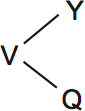
You can see that V goes before both Y and Q, because there is a line between V and both of those letters.
There is no relationship between Y and Q because no line directly connects those 2 letters.
Here’s rule 2:
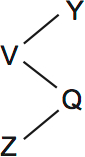
As you can see, we just add new rules on to the diagram.
It’s important to learn how to read these diagrams. There is no relation between Z and Y because there is no line between them. We can only read from left to right.
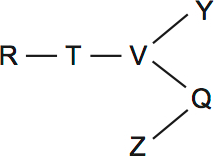
Here’s rule 3. R is before T and that T is before V:
How To Interpret These Diagrams
Some people understand this type of diagram instantly. But for others it’s not so easy.
If you’re still not sure how this works, put your finger on the R. You can see how R is connected to all the other letters by tracing a line from left to right with your finger.
If you can trace a continuous line from R to another letter without going backwards then R is before that letter.
If you have to go backwards or if there is no line between 2 letters then there is no relationship between the letters.
So R is before T, V, Y, and Q. You have to go backwards to connect R to Z, so there is no relationship between them.
Both R or Z could be 1st. Likewise both Y and Q could be last.
If you’re still not sure how to read the diagram, then go back and read over each individual rule and think about how they fit together.
Apply those rules to this diagram and see how to match everything up. Now let’s add rules 4 and 5. W is after R, and S is after V.
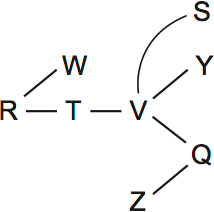
This Diagram Solves Everything
And we’re done. There’s no contrapositive because these rules aren’t conditional statements.
This is just an ordering diagram; it tells us who can go 1st, who can go last and how all variables are related to each other.
Since there is just one diagram it is very important that you understand. Look over the diagram and see who can go 1st and who can go last. R and Z are the only variables that can go 1st because no variables come before them. S, Y, W and Q are the only variables that can come last because no variables come after them.
Game 1 Main Diagram
The diagram below shows the rules that determine when the clowns(Q, R, S, T, V, W, Y, Z) can get out of the car and into the center ring.
Refer to these diagram when solving this game. Copy it on your own page, and on each question make a new version of them in order to follow along with my explanations. You’ll learn much more if you draw along.
The setup section explains how to build this diagram.
Main Diagram
Question 1
For list questions it’s better to use your rules than your main diagram. Pick one rule and go through the answer choices to see which ones you can eliminate using that rule.
A is wrong because T is before R.
B is wrong because Q is before V.
C is wrong because Q is before Z.
D is wrong because W is before R.
E is CORRECT, because it violates no rules.
Question 2
For a could be true question, you can eliminate answer choices by asking: does this have to be false?
A can’t be true because R, T and V must come before Y.
B can’t be true because only Z can go before R.
C can’t be true because R, T, V and Z must go before Q.
D could be true. S could be fifth if Z, Y and Q went after S. D is CORRECT.
E can’t be true because S, Y and Q all have to come after V.
Question 3
If Z is the seventh clown then Q must be the 8th clown. R must be first, because only Z could have gone before R.

A is wrong because only Z can normally go in front of R, but now Z is seventh.
B is wrong because now only R and W can go before T.
C is CORRECT. The only limit on W is that it cannot go before R. W can go anywhere from 2nd to 6th in this scenario.
D is wrong because now S, Y Z and W must go after V.
E is wrong because if Z goes seventh then Q goes eighth.
Question 4
If T goes fourth then both Z and W must go before T. We don’t know where Z has to go apart from that.
V must go fifth because V goes after T and because S, Y and Q all go after V.
The diagram below indicates that Z, R — T and W comes before T. The commas show that they could be in any order (as long as R is before T).

A could be true but it doesn’t have to be. R could go first and Z could go second or third.
B could be true but it doesn’t have to be. Z could go first, or third.
C could be true, but it doesn’t have to be. W could go second instead, and Z could go third.
D must be true. T goes, V goes after T and before S, Y and Q. There’s only room to place V in fifth. D is CORRECT.
E could be true, but doesn’t have to be. Y could also go sixth, if both S and Q went after Y.
Question 5
If Q is fifth then W, S and Y must all go after Q. It’s the only way to fill the three spots after Q.

A is wrong because Z could go anywhere in front of Q, including first.
B is wrong because T could go second if R went first and Z went after T.
C is wrong because V could go third if R and T went first and second and Z went after V.
D is CORRECT. W has to go after Q in order for us to place Q fifth.
E is wrong because it doesn’t matter where Y goes as long as it is after Q and V.
Question 6
If R is second then that means Z gets out before R. There’s no other variable that could go first.

All of the wrong answers talk about variables that have no rules linking the two of them.
A is wrong because there is no rule telling us whether S goes before or after T.
B is wrong because there is no rule telling us whether to put T before or after W.
C is wrong because there is no rule telling us where to put W, as long as it is after R.
D is wrong because there is no rule telling us where to put Y and Q in relation to each other.
E is CORRECT. Z has to go first if R goes second. Every other variable has to come after R.
Question 7
Some people find this question difficult, because we have to modify our diagram. But the process isn’t any different from when we did our initial setup. V goes before Z? So draw a line from V that shows it’s before Z. Then add in your other rule that says that Q goes after Z.
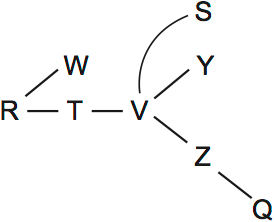
See, that wasn’t so hard. If you feel stuck on a question that asks you to change the rules, just change one thing at a time. You’ll eventually reach the goal that way.
A is wrong. R has to go first since Z now has to go after V.
B is wrong for the same reason. T now has to go second or third: only R and W can go before T.
C is wrong because R, T, V and Z all have to go before Q.
D is wrong because only R, W and T can go before V.
E is possible, and therefore CORRECT. R, T, V, W, and one of S or Y could all go before Z.
Game 2: Exhibition
Game 2 Setup
This is an explanation of the second logic game from Section II of LSAT Preptest 38, the October 2002 LSAT.
Frank, Gladys, and Leslie (F, G, L) are volunteers at a farm exhibition. Each of them will demonstrate two out of these six farming tasks: harvesting, milling, plowing, spinning, threshing, and weaving (H, M, P, S, T, W). You need to use the rules to determine who can demonstrate each task and what order they will present in.
Game Setup
This game is a mix of linear and grouping. We have to figure out which tasks the volunteers demonstrate, and the order they demonstrate the tasks.
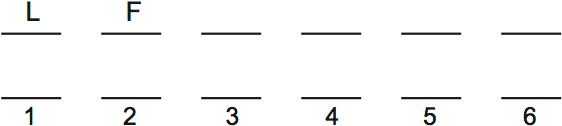
The first rule is incredibly important. Frank goes first, then Gladys, then Frank and Gladys in either order. It looks like this:

On it’s own, that doesn’t tell us much. But the second rule says that Frank can’t go in 1 or 6. So Frank can only go in second or third (for his first task.) If Frank goes in fourth, there’s no room for the two Gladys’ plus the other Frank.
We’ll get to the other rules after, but watch what happens if we put Frank in third.

There’s no other way to put it since Frank can’t go in 6. And that takes care of all the Franks and Gladys’. So only Leslie is left to go in spots one and two.

We’ll call this scenario 1, and come back to it later.
Scenario 2 isn’t as interesting. Putting Frank in 2 doesn’t let us figure much out. Though we do know Leslie goes first, because Gladys can’t go before Frank.

So Leslie always goes first, no matter what.
When doing a game, I might not figure out these ordering deductions the first time I look at the rules. That’s why I read them first and think about them briefly before drawing anything.
Look for rules that mention the same variable. These can be combined to make deductions.
Now that we have ordering figured out, let’s look at the other rules. They’re all about tasks.
Rules 3 and 4 tell us which tasks Gladys and Leslie can’t perform.
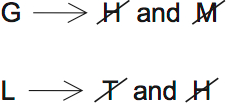
Both rules mention H. Since Gladys and Leslie can’t demonstrate H, only Frank is left. Frank must demonstrate H.
The next rule says that T must go right before M.

This TM rule produces interesting results in the first scenario. Leslie can’t demonstrate T, so only Frank or Gladys can demonstrate T.
Except, M comes after T. And Gladys can’t demonstrate M. So Frank can’t demonstrate T, because then M would be with Gladys.
So it must be Gladys that demonstrates T, and Frank demonstrates M. GF demonstrates TM.
The second Frank must demonstrate M, because it’s the only Frank with a Gladys in front.
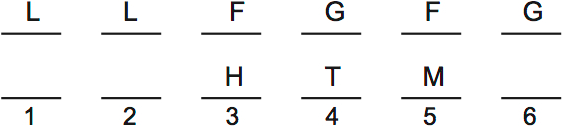
The first Frank therefore has to demonstrate harvesting (since no one else can demonstrate harvesting.)
That’s about all we can figure out. We know most things when Frank is in 3, but we don’t know very much when Frank is in 2. This game depends on knowing all the rules quite well.
It’s also important to note that W, S and P all have no rules.
Game 2 Main Diagram
These diagrams show the rules used to determine which volunteer (F, G, L) will present the demonstrations (H, M, P, S, T, W) and the order the demonstrations will appear in.
Refer to these diagrams when solving this game. Copy them on your own page, and on each question make a new version of them in order to follow along with my explanations. You’ll learn much more if you draw along.
The setup section explains how to build this diagram.
Main Diagram
Scenario 1
Scenario 2
Rules
- Gladys doesn’t demonstrate H or M.
- Leslie doesn’t demonstrate H or T.
- Frank therefore demonstrates H.
- Frank doesn’t go first or sixth.
- T is demonstrated directly before M.
- Leslie goes first (a deduction from the setup).
Question 8
For list questions, pick one rule and test each answer choice with that rule, eliminating them one by one.
A is wrong because Frank can’t be in 1.
B is wrong because two Franks are in front of the first Gladys.
C is CORRECT.
D is wrong because Gladys can’t demonstrate M.
E is wrong because T has to be directly in front of M. Here it is in front of S.
Question 9
When you see a general question, it’s a strong sign the LSAC expected you to make deductions using the rules.
Here, A is CORRECT. Rules 3 and 4 tell us that Gladys and Leslie both can’t demonstrate harvesting. So Frank must demonstrate harvesting.
The correct answer to question 8 shows that Leslie can demonstrate milling (rather than Frank) so B is wrong.
The correct answer to question 8 shows that Gladys can demonstrate threshing (rather than Frank.) So C is wrong.
Weaving, Plowing and Spinning all have no rules and could be demonstrated by anybody. That shows that D and E are wrong.
Question 10
If Leslie is 4th, then we are in scenario two.
There are four spaces after the first Frank, and we need to fit in 2 Gladys and one Frank.
The question just assigned Leslie to one of those four spaces.
(The other Leslie has to go in 1, because one Leslie always goes there.)
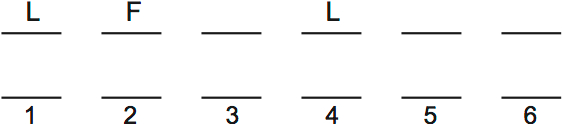
Since we can’t put Frank in 6th, Gladys must go there. And Gladys must also go third because we need a Gladys in between the two Franks.
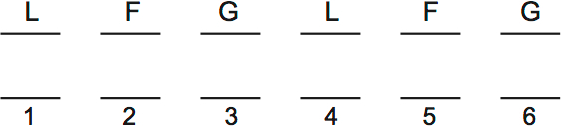
Harvesting can only be demonstrated second or fifth (since Frank has to demonstrate harvesting.)
B is CORRECT, since it says second and no answer choice says fifth.
Question 11
On this question, Gladys demonstrates P right before Frank demonstrates T.
M comes right after T. So we have the order PTM. M is demonstrated by Leslie since Gladys can’t demonstrate M.
It must be the second Frank that demonstrates T, because Gladys has to come after the first Frank.
There are two possible scenarios.
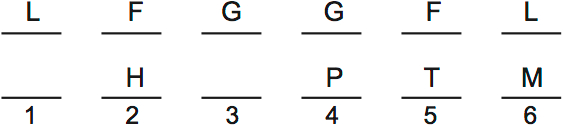
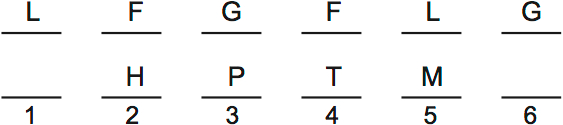
This must be true. Frank always demonstrates H. The second Frank demonstrates T, so the first Frank (in spot 2) demonstrates H. A is CORRECT.
B is wrong. There are no rules attached to spinning, so either Gladys or Leslie could demonstrate it.
C is wrong. There are no rules attached to weaving, so either Gladys or Leslie could demonstrate it.
D is wrong. Gladys can perform the fourth demonstration, but she doesn’t have to. In the lower scenario, Frank performs the fourth demonstration.
E is wrong, for the same reason as D. In the lower scenario, Gladys is in six instead of Leslie.
Question 12
This is a general, “must be true” question. We can use our rules and previous scenarios to show which answers could be false.
We know from the first scenario of our setup that Frank can go third. So A is wrong.
The two scenarios from Question 11 disprove B and C. Gladys doesn’t have to go in either 4 or 6.
Leslie always performs the first demonstration. Frank can’t go first, and Gladys goes after Frank. So D is CORRECT.
The scenarios from question 11 prove E is wrong. Frank can go second.
Question 13
For a could be true question all of the wrong answers will definitely be false.
A can’t be right because Frank is never first and only Frank can demonstrate H.
B M can’t go second because T has to go before M. Only Leslie can go first, and Leslie can’t demonstrate T.
C is wrong because Leslie goes first and Leslie can’t demonstrate T. It’s the same error as B.
D is wrong because M has to go after T. That can’t happen if T is last.
E is CORRECT. There are no rules attached to W. It can go anywhere that is open. Leslie always goes in spot 1, and we have no rules to tell us what Leslie must demonstrate. So Leslie could demonstrate W in spot 1.
Game 3: Job Applicants
Game 3 Setup
This is an explanation of the third logic game from Section II of LSAT Preptest 38, the October 2002 LSAT.
Chroma Inc. hired seven job applicants to fill seven new positions. The applicants are Feng, Garcia, Herrera, Ilias, Weiss, Xavier, and Yates (F, G, H, I, W, X, Y). One of them will work in the management department (M), three in the production department (P), and three in the sales department (S). You must determine the possible placements of the new hires to jobs.
Game Setup
This is a grouping game. Seven candidates are divided between three departments.
It might not be obvious how to draw the basic setup diagram. If you’re ever stuck on how to represent a game, you can glance down at the first question. The layout of the answers usually shows the most efficient way to draw everything.
We should put the departments vertically. I’ve placed F in P because the last rule says F goes there.
(It’s important to read the rules first, in part because you can spot some obvious rules that go directly on the diagram)
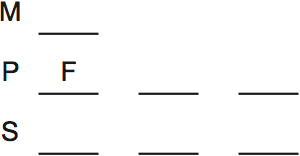
The first two rules tell us that H and Y must go together and that F and G can’t go together.
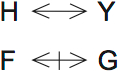
It’s important to realize that H and Y form a pretty restrictive bloc. They can only go in P or S, and they’ll take two of the three spaces.
The rule that F and G can’t go together tells us that G goes in M or S, since F is in P. You can add “not G” beside P in all future diagrams.
The next rule says that if X is in S, then W is in S. We can draw this using sub-scripts.

You might think this game looks pretty open ended. But it would be a big mistake to stop here. None of the rules can be directly combined, but we can still draw deductions.
Look for the most restrictive variable. There are only two options for placing H and Y. We can put them in P, or we can put them in S.
When there are only two options, you should always try both. Often it leads to deductions.
If we put H and Y in P, then everything is settled. X has to go in M.
Why? Well, if X went in S, then W would have to go in P (rule 3). But P is full. So X goes in M, not S.
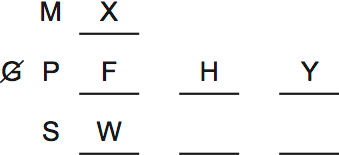
G and I take up the other two spaces in S because every other spot is full.
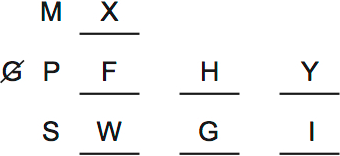
We’ll call that scenario 1.
There are a couple of possibilities if H and Y go in S instead of P.
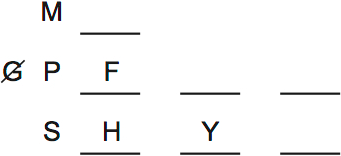
If X also goes in S then W goes in P (rule 3).
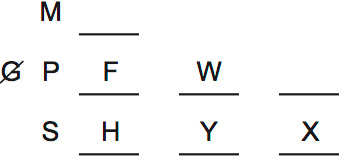
G then has to go in M, because G can’t go with F in P. That leaves I to go in P.
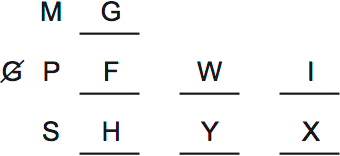
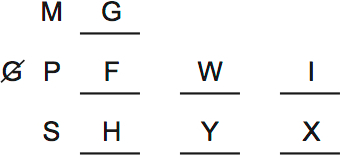
We’ll call that scenario 2.
The third alternative is simply where X doesn’t go in S. It could go in P or M. G can go in M or S, but not P since F and G can’t go together.
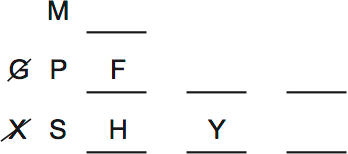
We got these scenarios first by seeing where we could put HY. Then we added in the third rule, Xs ➞ Wp
Scenarios aren’t essential, but I find they help us think through the rules.
Game 3 Main Diagram
These diagrams show the rules used to determine the possible placement of new hires (F, G, H, I, W, X, Y) to jobs (M, P, S).
Refer to these diagrams when solving this game. Copy them on your own page, and on each question make a new version of them in order to follow along with my explanations. You’ll learn much more if you draw along.
The setup section explains how to build this diagram.
Main Diagram
Scenario 1

Scenario 2
Scenario 3
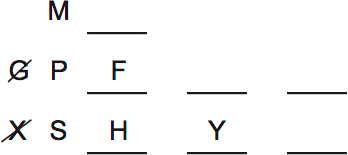
Rules:
- If X is in S, then W is in P.
- Always put H and Y together.
- Don’t put F and G together.
- Put F in P.
- There are no rules for I.
Question 14
As with all list questions, pick a rule and test each answer choice to see if it violates the rule.
A is wrong because when X is in S, W has to be in P. That’s the third rule.
B is wrong because F isn’t in P. That’s the fourth rule.
C is wrong because F can’t be with G. That’s the second rule.
D is wrong because H and Y aren’t together. That’s the first rule.
E is CORRECT.
Question 15
We know F is always in P. And G cannot be in the same group as F. So the right answer has to include G.
That leaves only answer choices B and D. Either it’s only G that can’t go in P, or it’s G, H and Y.
We know from scenario 1 that H and Y can go in P.
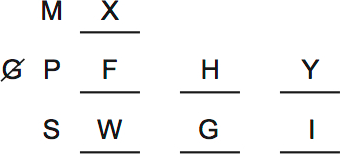
So D is CORRECT. Only G can’t go in P.
Question 16
We’re trying to lock down all the variables. Ilias is the variable with no rules: the hardest variable to lock down. It makes sense to start with the answer choices that mention Ilias.
C is CORRECT. If we put W and Ilias in S, then we need to put H and Y in P, because it’s the only place they’ll fit. That fills up P.
We still have to place G and X. We can’t put X in S. Why? Because if X is in S, then W must go in P (3rd rule).
But this answer choice tells us W is in S, not P. So X must go in M.
We therefore place G in the open space in S.
In other words, C describes our first scenario:
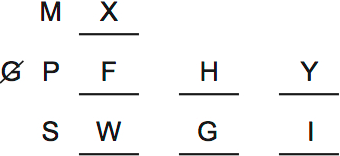
D is wrong because it doesn’t let us decide where to put X, W and I. Any of them can go in M or P.
E is wrong because it doesn’t let us decide whether to put W/G in M or S.
A is wrong because we already knew F was in P. This only tells us where W goes. I and G are interchangeable in this scenario.
B is wrong because we don’t know how to place X, W and I. They could go in M or P.
Question 17
Since we’re placing variables in sales, we should figure out which rules apply to sales.

That’s the only rule specific to sales. Start with answer choices that involve X being in sales.
B is CORRECT. This isn’t possible. If X and G are in sales then H and Y are forced to go in P along with F. That fills up P. But X being in S means that W also has to go in P. There’s no room!
E involves X, but the scenario works and so the answer isn’t right. H, Y and X are all in S. W has to go in P along with F. G must go in M to avoid F. That leaves I able to go in P, which works.
A is fine. H and Y go in P. W goes in S and X goes in M (X has to go in M so that he doesn’t force W into P.)
C is fine because it means H, Y and G are all in S. That allows us to put X, W and I in either P and M. No rules apply to them when they’re in P or M.
D is fine because it means H, Y and W are in S. That leaves G to go in M (so it avoids F). X and I can go in P, as there are no rules that apply to them when they are in P.
Question 18
We know F is in P. This new rule tells us X must be in P too.
That forces H and Y to go in S, as that’s the only place that has room for them. The only other restriction is that G can’t go in P.
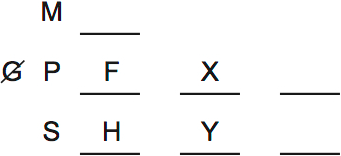
A is wrong because G’s only restriction is that he can’t go in P.
B is CORRECT. H and Y must go together. There is no longer room for them in P, so H can’t go in P.
C is wrong because Ilias can go anywhere. There are no rules that cover Ilias, and this scenario doesn’t force Ilias to be in any particular spot.
D is wrong because there are no rules attached to W apart from the rule that W is in P if X is in S. But X isn’t in S, so W can go anywhere.
E is wrong for the same reason as D.
Question 19
If X isn’t hired for P, then there must be a split of G and X between S and M. G can’t go in P either.
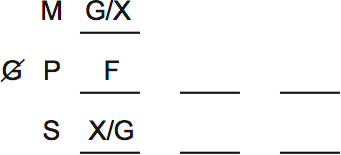
A is wrong because F can never be hired in sales. Rule 4 says F goes in P.
B is wrong because Y always goes with H. This answer choice therefore wants us to put H, Y and W in S. But we only have two spaces.
C could be true and is therefore CORRECT. F is already in P, so we just have to add H and Y. Then W and Ilias could go in S. X goes in M to avoid forcing W into P.
D is wrong because Garcia can never be hired for production. The second rule says that F and G never go together, and F is always in the production department.
E is wrong because H and Y always go together. So this answer choice wants us to put H, Y and W all in P along with F. That’s four people for three spaces.
Game 4: Performances
Game 4 Setup
This is an explanation of the fourth logic game from Section II of LSAT Preptest 38, the October 2002 LSAT.
Five musical pieces: Nexus, Onyx, Synchrony, Tailwind, and Virtual (N, O, S, T, V) will be performed successively by a group of musicians. Two instruments will be used for each piece: Nexus with fiddle and lute (F, L), Onyx with harp and mandolin (H, M), Synchrony with guitar and harp (G, H), Tailwind with fiddle and guitar (F, G), and Virtual with lute and mandolin (L, M). You must determine the possible order of the pieces and instruments being shared between them.
Game Setup
This game looks superficially linear, but it’s really more of a grouping game. The most important element is mastery of the rules; we’re not able to deduce much during the setup.
Each piece is performed by two instruments. It’s important to write this down somewhere you’ll be able to see it clearly and refer back to it.
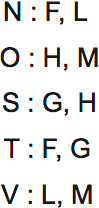
We only have two rules:
- N or T goes second
- Each piece must share an instrument with the piece before or after it.
The second rule does not mean that a piece has to share instruments with both of the pieces beside it: one is enough.
That’s a common mistake on this game, so I’ll say it again: A piece only has to be linked with either the piece before it or the piece behind it.
A piece does not have to be linked to both the pieces before and behind it.
I found it useful to write down the pieces that could go beside each piece. For instance: N plays F or L. T has F and V has L, so N needs one of either T or V beside it.

Keep the above chart somewhere you can refer to it easily. The game depends on quick access to this information.
Finally, here’s how we can layout the five pieces.

The lines underneath show where we must have links. The piece is spot 1 can only be linked to the piece in spot 2. There doesn’t have to be a link between 2 and 3, because the piece in spot 3 could be linked to the piece in spot 4 (while spot 2 is linked to spot 1.)
Therefore, when N is in 2, either T or V must be in 1. They’re the only ones who could allow a link between 1 and 2. When T is in 2, one of N or S must be in 1.
Game 4 Main Diagram
These diagrams show the rules used to determine the possible order and instruments (F, L, H, M, G) shared by the musicians to perform the pieces (N, O, S, T, V).
Refer to these diagrams when solving this game. Copy them on your own page, and on each question make a new version of them in order to follow along with my explanations. You’ll learn much more if you draw along.
The setup section explains how to build this diagram.
Main Diagram



Question 20
As with all list questions, go through the rules one at a time and eliminate answer choices one by one. In this case, choose one piece, and check whether it shares an instrument with at least one piece beside it in each answer choice.
A is wrong because S is in 2. Only N or T can go in 2.
B is wrong because O needs to be beside S or V. Instead, O is between N and T.
C is wrong because S needs to be beside O or T. Instead S is beside V.
D is CORRECT.
E is wrong because T needs to be beside N or S. Instead, T is beside O.
Question 21
There’s a fast, easy way and a hard, tedious way to answer this question. The long and the hard way involves drawing out each scenario. I prefer the fast and easy way.
Ask yourself what the most restricted variables are. Only N and T have special rules. And they share an instrument: the fiddle. They’re the only ones who play the fiddle.
So if the fiddle is in spots 3 and 4 then N and T have to be in spots 3 and 4. Check if it works.
It doesn’t work, because one of N and T has to be in spot 2. So A is CORRECT.
None of the other instruments have any restrictions. S and T could play the guitar in 3 and 4, N and S could play the harp in 3 and 4, V and N could play the lute in 3 and 4, and V and O could play the mandolin in 3 and 4.
All of those scenarios still allow one of N or T to be in the second spot.
Question 22
This question changes our rules. Now we need links between every spot.

My instinct is that the right answer will involve one of the variables that can be linked with N and T: S or V. They’re the obvious choice to test first, because only N/T have rules.
And that turns out to be true. A is CORRECT. V can go in 1.

When you put V in 1, N has to go in 2. Then T has to go in 3, because it’s the only other piece linked with N. Then S is the second instrument linked with T. Then O is the second instrument linked with S.
B is wrong because N or T always has to come second.
C is wrong because O shares no links with N or T. So there would be a gap between 2 and 3.
D and E are wrong because N and T both play F. So N and T have to be beside each other. Otherwise there’s no way to link the piece in spot 2 with both spot 1 and spot 3. We have to do that, thanks to the new rule in this question.
Question 23
We need a link between the first piece and the second piece.
N, S, T and V all share links with N and T (the pieces that can go second.) So any one of them could go in 1.
Onyx doesn’t share an instrument. Onyx can only go beside S or V. So B is CORRECT. If Onyx goes in 1 then we won’t have a link between 1 and 2.
Question 24
If S goes fifth, then O or T has to go fourth. They’re the only two pieces that can go beside O, and we need a link between 4 and 5.
Watch what happens if we put T in 4:

We have to put N in 2, and then we can link it with V in 1. But then O is left to go in 3. And O has no links with N or T. So this scenario doesn’t work.
So O has to go in 4. It’s pretty easy to place the rest. N and V share links, and T and N share links. Every combination works as long as we don’t put V in 1 and T in 2.

We can’t put N third. T would be in second, and V would be in first. But T and V don’t share a link. So A is wrong.
B is wrong because O has to be fourth. We saw that putting T fourth doesn’t work.
C is wrong for the same reason as B.
D is possible. N could go second, so V and N would link the first two spots. T could then go third, where it would be linked with N.
We don’t need a link between 3 and 4, because O and S are linked in 4 and 5. So every variable has a link with at least one of the pieces beside it, and D is CORRECT. It’s drawn below.

E is wrong because only N or T can go second.

Leave a Reply