
LSAT Preptest 35 LG Explanations
Full explanations for every question from the logic games section of LSAT Preptest 35.
Archived Logic Games explanations
Logic Games are no longer part of the LSAT. LSAC removed the Logic Games section beginning with the August 2024 LSAT. If you are studying for the current LSAT, you can skip this section.
These explanations remain available for students, tutors, and readers using old-format PrepTests. For current guidance, see Logic Games and the current LSAT.
Table of contents
Game 1: Astronauts
Game 1 Setup
This is an explanation of the first logic game from Section III of LSAT Preptest 35, the October 2001 LSAT.
Four astronauts are needed for a space flight. There are eight candidates: four experienced astronauts – F, J, K, and L; and four inexperienced astronauts – M, N, P, and T. The group has four geologists (F, M, P, and T) and four radiobiologists (J, K, L, and N).
Game Setup
This is an in/out game. Many students find it difficult. I think it tests an incredibly important skill: how well and how quickly you can use a diagram.
Note that this is not like the in-out games from tests 33 and 34. The diagram is completely different.
This is actually a very simple game. We’ve got to pick four astronauts. Two are experienced, and two aren’t. Two of them need to be radiobiologists, and two have to be geologists. Lastly, either P or L or both have to be included.
That’s it.
Here’s my drawing that explains everything. Now, your first impression might be “huh?”, but give it a chance. It will let you solve everything very quickly:
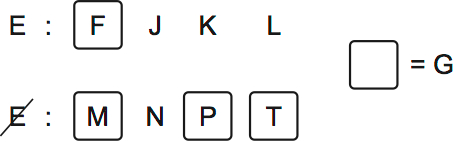
It’s just a list of the experienced and inexperienced astronauts. I’ve put a box around those that are geographers. Those that are radiobiologists aren’t highlighted.
I’ve seen people use this vertically, or put another symbol around the radiobiologists, or make any number of stylistic changes. That’s fine. Draw it in a way that makes sense to you. But make sure you understand the logic. Here are the rules.
- You need two people from each row. (E/not E)
- You need two people with a box, and two people without a box.
- You need to include either P or L.
Study the diagram well. I’m going to reproduce it with each question.
The questions are mostly local rules. For instance, question two tells you that F and P are included. They both have a box, so they’re geologists. So look at your diagram: who else do you need?
You’ll need N (an inexperienced radiobiologist) and one of J/K/L (experienced radiobiologists.) That’s answer choice A. Done.
So the steps are:
- Check who the local rule selects.
- Look at the diagram, and count how many astronauts of each type that gives you.
- Figure out which other types you need to fill your quotas (experienced vs. inexperienced, R vs. G, do we have L or P?)
- Figure out which of the remaining astronauts therefore have to go, and who else could go. It won’t be very many.
- Check what the question is asking for, and choose the right answer.
- Score perfectly on this game!
Game 1 Main Diagram
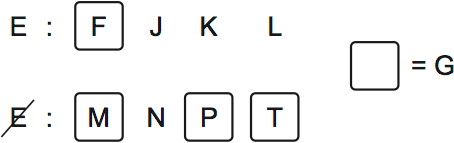
These diagrams show the rules used to determine the four astronauts from a group of eight who will go on a space flight (F, J, K, L, M, N, P, T). The astronauts are either radiobiologists or geologists. The boxes indicate geologists, the rest are radiobiologists. The astronauts are either experienced or inexperienced (E, E)
Refer to these diagrams when solving this game. Copy them on your own page, and on each question make a new version of them in order to follow along with my explanations. You’ll learn much more if you draw along.
The setup section explains how to build this diagram.
Main Diagram
Question 1
A doesn’t have P or L.
B has three geologists: F, M and P.
C has too many geologists: F, M, P
D is CORRECT. It has two from each group, and L is included.
E has too many radiobiologists. K, L and N.
Question 2
The local rule says we have F and P. We’re missing two radiobiologists, one of whom has to be inexperienced, and one of whom should be experienced. We need N + one of J/K/L.
A is CORRECT.
All of the other answer choices must is false. For B, we already have enough geologists. C would give us three experienced astronauts. D and E would give us three experienced astronauts and three inexperienced astronauts, respectively.
Question 3
F and J. Those are our experienced astronauts. We need one inexperienced radiobiologist and one inexperienced geologist. And we need P, because we don’t have L.
So that means we need P (geologist) and therefore N as well (radiobiologist). D is CORRECT.
We can’t choose K (answer A) because we already have two experienced astronauts. Same for L (answer B). M can’t be selected, because P has to be the inexperienced geologist since we don’t have L (answer C). Same for T (Answer E).
Question 4
M and T are two inexperienced geologists. That means we need two experienced radiobiologists. And we also need L, because we don’t have P.
So we need L, and could have either J or K.
B is CORRECT. J could be chosen but doesn’t have to be.
We can’t choose F (answer A). We have to choose L (answer C). We can’t choose N, because we already have enough inexperienced astronauts (answer D.) Same for P (answer E).
Question 5
If N is selected, then the we’ll have to pick a geologist to be the other inexperienced astronaut. We can pick either M, P or T.
That means we need one geologist and one radiobiologist from the experienced astronauts. F is the only geologist, so A is CORRECT.
J, L, M and T all could be selected (answer choices B-D), but none of them have to be.
Game 2: New Cars
Game 2 Setup
This is an explanation of the second logic game from Section III of LSAT Preptest 35, the October 2001 LSAT.
There are six new cars in a showroom: T, V, W, X, Y, and Z. Each car has at least one of these features: power windows, leather interior, and sunroof (P, L, S). You need to match features to cars based on the rules.
Game Setup
This is a grouping game. We have to match features to cars: the cars either have a feature or they don’t. We can make many deductions by combining rules.
The first question is whether to set this up vertically or horizontally. I find a vertical diagram best, but you can draw it differently if you prefer.
If you read through the rules, you’ll see that the cars are the base units, and you have to decide which features they have. Each car has at least one option.
Here’s how I drew it. Each car has three possibilities: P, L or S, so I drew three spaces by each car.
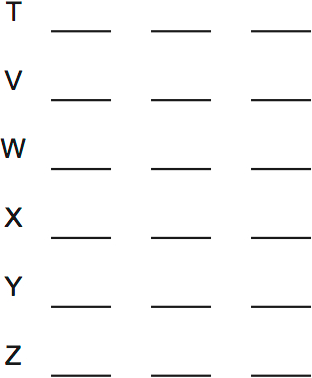
The first two rules are simple. They just tell us which options V and W have.
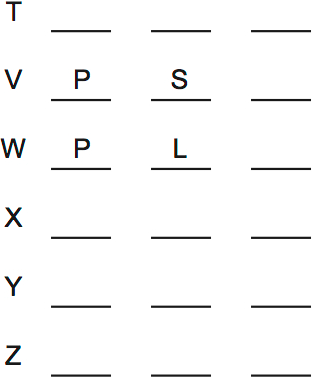
At this point, we’re not told those are the only options V and W have. As far as we know, those cars could have a third feature.
The next rule is more restrictive. Y doesn’t have any option that W has. Since W already has two options, that means Y must have the third: S.
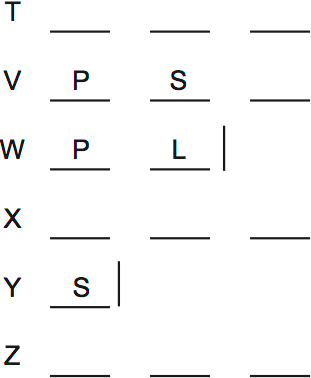
Further, now W can’t have S. If W did have S then it would have an option in common with Y. So Y can only have one option, and W can only have two. I’ve drawn a vertical line to indicate that they can’t have any more.
V’s lack of vertical line means it can have 2 or 3 options.
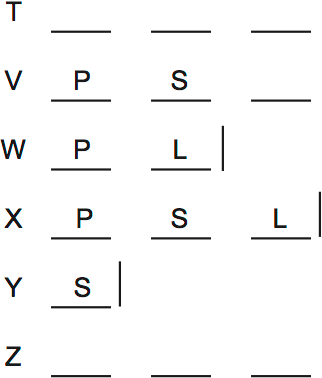
The next rule is also quite informative. X has a larger number of options than W. Since W has 2, X must therefore have all 3 options.
The next rules says that V and Z have exactly one option in common. Z can’t have three options, otherwise it would share two with V.
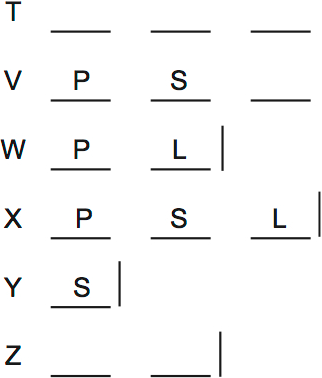
The last rule almost completely locks down the game. Z has more options than T. That means Z must have two options, since T has to have at least one.
That means Z has L, and one of P/S. We also know V can’t have L, because Z and V only share one option.
We don’t know which option T has, but it can only have one, since Z has more options.
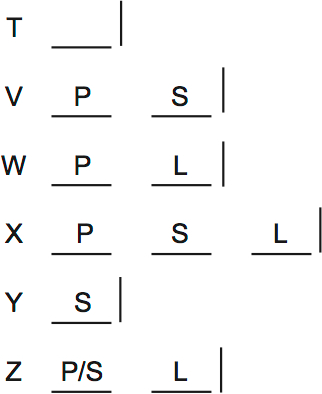
Wow. There isn’t much to decide here, is there? The only options are whether Z has P or S, and which option T has.
Game 2 Main Diagram
This diagram shows the rules used to determine the possible features (P, L, S) the cars have (T, V, W, X, Y, Z).
Refer to this diagram when solving this game. Copy it on your own page, and on each question make a new version in order to follow along with my explanations. You’ll learn much more if you draw along.
The setup section explains how to build this diagram.
Main Diagram
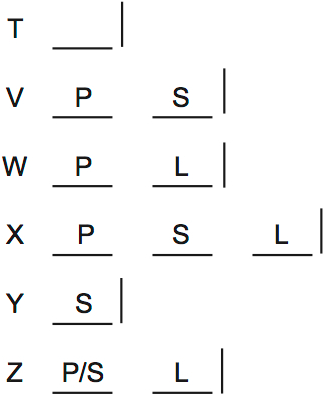
Question 6
Just count from the Main Diagram. We don’t know about T and Z, but we know exactly which options the other four cars have.
C is the CORRECT.
Whenever you see a question like this, it’s a strong sign you should have made many deductions in your setup.
Question 7
A can’t be true. At most Z, X, W and T can have leather interiors. A is CORRECT.
B can be true since Z, Y, X, V and T could all have sunroofs.
C can be true because Z, X, W and T can have leather interiors.
D can be true since, Z, Y, X and V can all have power windows.
E can be true since Z, Y, X, V and T can all have sunroofs (but T and Z don’t have to). So we can have four sunroofs, but we don’t have to.
Question 8
For this question, if you have leather you also have power windows. This tells us two things. Z has power windows, and T doesn’t have leather, because it has no space to also have power windows. Here’s the local diagram:
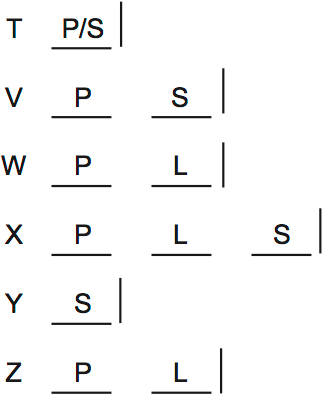
For A, T can have power windows. The only thing T can’t have is L, because that would force T to have P as well.
B can be true. The only thing T can’t have is L, because that would force T to have P as well.
C could be true. Z, X, W and V have power windows and T could have a sunroof.
D has to be true, since every car with L needs P.
E can’t be true. The fact that Z has L tells us that Z also needs to have P instead of S for its second feature. E is CORRECT.
Question 9
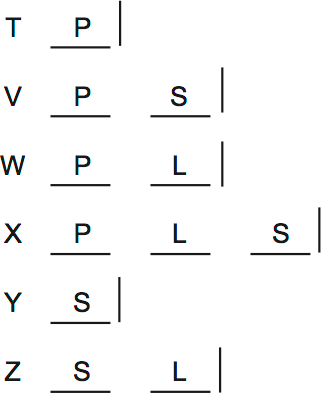
For Z to have options in common with all cars apart from T, it must have S, because S is Y’s only option. The local diagram is drawn above.
Since Z now has S and L, then T must have P so that T and Z have no option in common.
A must be true.
B must be true.
C must be true. X, W, V and T all have P.
D must be false. Only Z, X and W have L. T can’t, because T needs P. D is CORRECT.
E must be true. Z, X, V and T all have S.
Question 10
No car has exactly the same options for this question. Let’s look at the two things we can actually change.
T must have L or P, so that it doesn’t have the same option as Y.
Z must have S, so that it doesn’t have the same options as W.
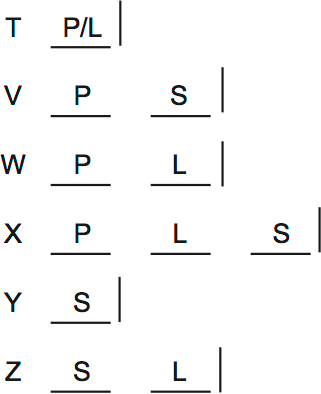
A could be true, if T has L.
B could be true, if T has P. Then X, W, V and T would all have P.
C cannot be true. Z, Y, X and V all have sunroofs. C is CORRECT.
D has to be true. Z, Y, X and V all have sunroofs and T can’t have a sunroof.
E could be true if T has L. Then Z, X, W and T would all have L.
Question 11
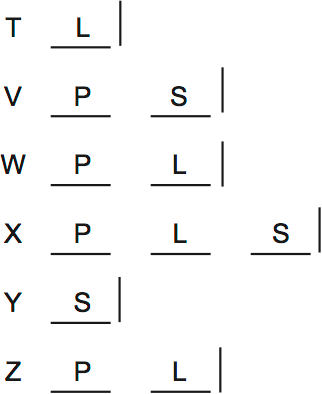
Four cars have P and four have L.
T is the only car that can have an extra L. That leaves Z as the only car that can have an extra P.
So T: L
And Z: P and L
A is true. T has L and V has P and S.
B is true. T has L and Y has S.
C is true. T has L and so does Z.
D is false. Z has P and L, and so does W. D is CORRECT.
E is true. Y has S and Z has P and L.
Question 12
You have to look back at your rules here and make sure which rules involve X. It turns out only one does.
So now X has the same options as W: P and L. X could also have S, but it no longer has to.
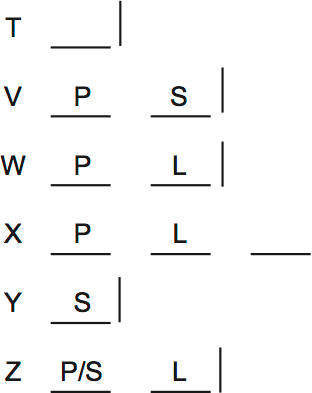
A could be true, if T has S and X doesn’t have a third option.
B could be true, if X doesn’t have a third option.
C could be true, if X does have S, a third option.
D must be false. X and Z always have options in common. D is CORRECT.
E could be true, if Z has P.
Game 3: Opera Seating
Game 3 Setup
This is an explanation of the third logic game from Section III of LSAT Preptest 35, the October 2001 LSAT.
Five members of the Kim family attend an opera. They are Quentin, Robert, Shiro, Tony, and Umeko (Q, R, S, T, U). Each of them sits in either row G or H, and their seats are numbered 1 through 3.
Game Setup
Time for a night at the opera. But where to sit? There are five people and six seats. And everybody has to sit beside someone. So the seats in the middle can’t be empty. It’s not much fun to go to the opera and sit all by yourself.
Here’s the setup plus the first rule:
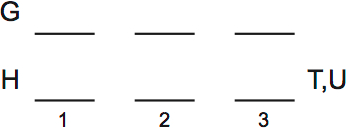
Two horizontal rows of three seats. T and U have to be in row H, so I’ve drawn them beside it.
The next rule tells us that T comes after S and U. T and U are in row H. We don’t know which row S is in; it could be in row G. We also don’t know whether U or S comes first.

The third rule tells us that R needs either Q or S in the same row.

And the last rule tells us R is in seat two. We can combine this with the other rules to figure out that R must be in the second seat of row G.
R needs at least one other variable with it: Q or S. So there must be space for two variables in R’s row.
But row H only has space for one variable: T and U are already there.
So R is in seat 2 of row G.
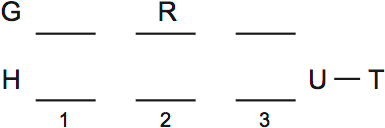
I’ve added a line between U and T to indicate that T goes first.
At this point, you might think we’re done. Not so fast! We still get to do my very favorite thing: split the setup into two scenarios.
Always be on the lookout for this. It can be tricky to develop an intuition for it. The place to start is to look at the most restricted variables. In this case, U and S must go before T. There aren’t many ways to do that.
If U and S both go in row H, then we get this scenario:
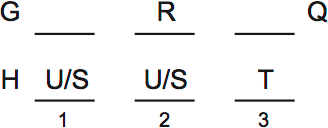
It doesn’t matter where Q goes.
If we put S in row G, then it can’t go in the third spot. It wouldn’t be before T. It can only go in the first spot. (U can’t go in row G, because of the first rule)
Here’s what we get:
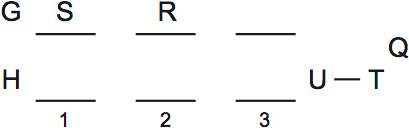
I placed Q in the middle to show that it could be either in row G or H.
The rule about R having to be with Q or S is superfluous. Every correct scenario automatically takes care of that.
There’s only one more thing to remember about this scenario: the second seat in row H always has to be full. The first rule says that everyone sits beside someone else.
If it helps you remember, draw U/T/Q in there to show that somebody has to fill that seat.
And that’s it. There’s no other way to place S, so there’s really only two scenarios in this game!
Game 3 Main Diagram
These diagrams show the rules used to determine the possible seating arrangements (G1, G2, G3, H1, H2, H3) of the Kim family (Q, R, S, T, U) at the opera.
Refer to these diagrams when solving this game. Copy them on your own page, and on each question make a new version of them in order to follow along with my explanations. You’ll learn much more if you draw along.
The setup section explains how to build this diagram.
Main Diagram
Scenario 1
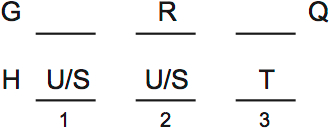
Scenario 2
Question 13
The first two questions are general questions. No local rules, no sifting through five lists of possible setups.
When you see that, it means that the LSAC really expected you to make a lot of deductions. It’s a strong sign to take another look at your diagrams to see if you missed something.
A could be true, in the second scenario. We could have U and T in 1 and 2, and Q in seat 3 of H. A is CORRECT.
B can never be true. Then the poor people in H1 and H3 wouldn’t have anyone beside them.
C can’t be true, because S always has to be before T.
D is wrong because T can’t be in 1. He needs S and U to the left of him.
E is wrong because U has to be in front of T.
Question 14
R can’t be in H, because R is always with Q or S. And there aren’t two free spots for them in H, because T and U are there. So A is wrong.
S can be in row H in the first scenario. B is CORRECT.
C is wrong because in the first scenario S and Q are in different rows. In the second scenario Q and S can both be in row G but they are separated by R.
D is wrong because R can’t fit into row H, because he needs Q or S along with him.
E is wrong for the same reason D is.
Question 15
If T is in 2, then U must be in H1. S has to go in G1 to be numbered lower than T. Q can go in either row.
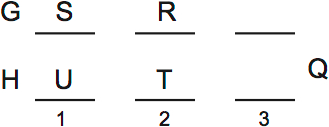
A is wrong because Q is always in seat 3.
B is wrong because U is always in 1.
C could be false. Q could sit in row H rather than beside Robert. C is CORRECT.
D is wrong. S has to be beside R because it’s the only way for S to be in a lower numbered row than T.
E is wrong because U has to go directly before T.
Question 16
The scenario from question 15 proves that G3 and H3 can be empty. E is the only answer that has those two spots listed. E is CORRECT.
Using past scenarios can really help speed you up on this type of question.
Another trick is to use limiting factors. If you find that H3 can be empty, then any answer without H3 is wrong.
Here are some scenarios that prove the other spots can be empty.
Scenario 1 proves that G1 could be empty. Q can go in the third spot.
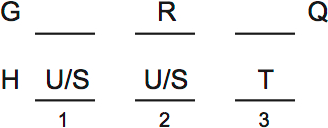
This next scenario proves that H1 can be empty.
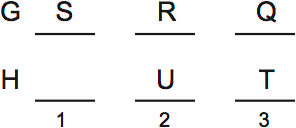
Question 17
Scenario 1 proves that U and S can sit in H2.
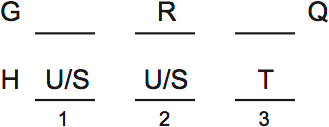
The scenario from question 15 shows that T can sit there.
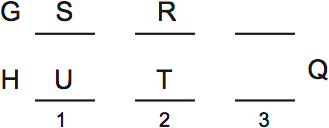
And the diagram below shows that Q can go there. It’s based on scenario 2.
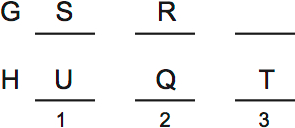
E is CORRECT.
Game 4: Professors
Game 4 Setup
This is an explanation of the fourth logic game from Section III of LSAT Preptest 35, the October 2001 LSAT.
Seven professors were hired from 1989 to 1995. The professors are: Madison, Nilsson, Orozco, Paton, Robinson, Sarkis, and Togo (M, N, O, P, R, S, T). Each of them has at least one specialty but no two professors that were hired in the same or consecutive years share a common specialty.
Game Setup
This is a normal linear game in disguise. It has seven spaces, one after each other. Except this game calls them 1989-1995.
The only other thing that makes this game different is that more than one professor can be hired in each year.
We can draw the layout and the first rule like this:

The second rules tells us that M, O and T can’t be beside each other or hired in the same year. We could draw this a few different ways. I choose to put the variables underneath the spaces where they can’t go, and put lines through them.
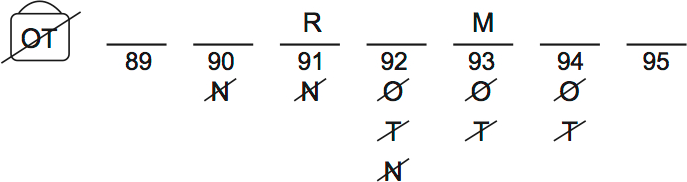
We don’t know where O and T might go, so I drew the box with a suitcase handle to show that they can’t go beside each other, in either order.
(Note: a smarter method would have been to read through all the rules first, and notice you can put O directly in 1990)
The next rule tells you that N and R have a specialty in common. That means that N can’t go in 1990, 1991 or 1992.
The next rule lets you place N in 1989. The rule says that P and S come before M but after N.

The only place N could go is 1989.
Why? 1989, 90, 91 and 92 are the only spots before M, and you already know you can’t put N in 90, 91 and 92.
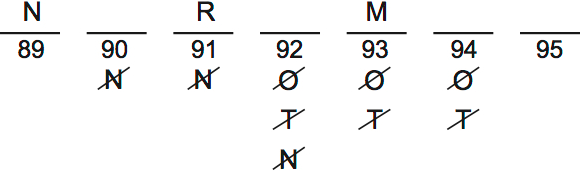
The next rule lets you solve almost everything. O was hired in 1990, and S can’t go beside O. So S can’t go in 89, 90 or 91. Since S has to go before M, S must therefore go in 1992.
And what about T? We know T can’t go in 92, 93 and 94. Now that O is in 1990, T can’t go in 89, 90 or 91, because O and T can’t go beside each other. So T has to go in 1995.
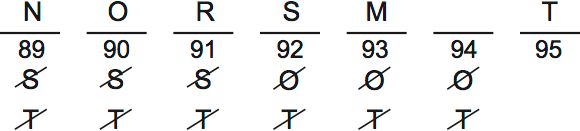
The only person left to place is P! P can go in 1990, 1991 or 1992, because P has to go between N and M.
As you can see, there’s no huge trick to getting this kind of diagram set up. All I’ve done is looked at each rule, and asked if I could make any deductions by combining the rule with the previous rules. Look for variables in common, and think about which variables are most restricted. The LSAT is expecting people to make these types of diagrams.
A big factor in the questions will be whether P ends up sharing a specialty with any professors.
Game 4 Main Diagram
These diagrams show the rules used to determine the possible year (89, 90, 91, 92, 93, 94, 95) that each professor (M, N, O, P, R, S, T) was hired in.
Refer to these diagrams when solving this game. Copy them on your own page, and on each question make a new version of them in order to follow along with my explanations. You’ll learn much more if you draw along.
The setup section explains how to build this diagram.
Main Diagram

P is the only uncertain variable. It’s between N and M:

If you’re unsure about this diagram, draw it on your own, following the setup.
Question 18
If we look at our main diagram and count, we see that N, O and R have to have been hired in 1989-91. And P could have been hired in 89-91, so we can include P as well. C is CORRECT.
We can see from the diagram that S, M and T all have to be after 1991.
Question 19
If only one professor was hired in 1991 then P was hired in another year: either 1990 or 1992.
A could be true, if P was hired in 1990. Then P wouldn’t be beside M. A is CORRECT.
B can never be true, even without the local rule. R and S are always beside each other.
C is wrong. One year after Orozco is 1991, and we know only one professor can be hired that year. R is already there.
D is wrong. No professor can ever be hired in 1994.
E is wrong. P can never be hired in 1993. Only M can be hired that year.
Question 20
(Diagram and explanation below)

A must be true, from the diagram. N is always in 1989.
B could be true. P can be hired anytime between 90-92
C could be true. P can be hired anytime between 90-92
D must be true, from the diagram. S is always hired in 1992.
E must be false. T can’t be hired in 1994 because T and M share a specialty. E is CORRECT.
Question 21
A doesn’t have to be true, since O could be hired in the same year as P: 1990.
B doesn’t have to be true, if P was hired in 1992.
C can’t be true. R is always in 1991 and S is always in 1992, after R.
D must be true. R is in 1991 and S is in 1992. D is CORRECT.
E can’t be true. M is in 1993 and S is in 1992.
Question 22
(Diagram and explanation below)

I reproduced the diagram above. For this question, two professors are hired in 1992. P is the only professor left to place, so now they have to go in 1992 with S.
This lets us conclude that P doesn’t share a specialty with R, S or M.
A could be true and is therefore CORRECT. Neither O nor T are beside P if P is in 1992.
B must be false. P is beside M.
C must be false. P was the only professor left to place and we had to put them in 1992.
D must be false. P can never go in 1993.
E must be false. P has to be hired in 1992, since they are the only professor we had left to place.
Question 23
If P and M share a specialty then P must not be in 1992.
So P is in 1991 or 1990. That means P is beside O, and therefore P can’t share a specialty with O.
A doesn’t have to be true since P could go in 1991.
B could be false, because P could also go in 1990.
C could be false, because P could go in 1991 along with R.
D must be false. We can never have more than one year with two professors (the year with P.)
E must be true: P can’t go in 1992 and therefore P is hired before S. E is CORRECT.

Leave a Reply