
LSAT Preptest 30 LG Explanations
Full explanations for every question from the logic games section of LSAT Preptest 30.
Archived Logic Games explanations
Logic Games are no longer part of the LSAT. LSAC removed the Logic Games section beginning with the August 2024 LSAT. If you are studying for the current LSAT, you can skip this section.
These explanations remain available for students, tutors, and readers using old-format PrepTests. For current guidance, see Logic Games and the current LSAT.
Table of contents
Game 1: Bakery Bread
Game 1 Setup
This is an explanation of the first logic game from Section I of LSAT Preptest 30, the December 1999 LSAT.
A bakery will make one delivery consisting six loaves of bread. Each loaf is one of three kinds: oatmeal, rye, or wheat (O, R, W) and each is either sliced or unsliced (s, u). You must use the rules to determine the possible combinations of the bread loaves.
Game Setup
This is a grouping game. Numbers are the most important factor. We need six loaves of bread.
This game is unusual in that we can’t combine many rules to make deductions.
Instead, it’s essential to know the rules, and apply them on the questions. I recommend making a numbered list you can quickly refer to.
- Two kinds of loaves, at least.
- Less than four rye.
- Only sliced wheat.
- One unsliced oatmeal, always.
- The second unsliced loaf is rye.
(On an actual LSAT, I would shorten these. i.e. Unsliced Wheat ➞ Wu)
You’ll notice I changed the wording of the rules. It’s helpful on games to be able to refer to the same idea using different words.
The last rule is the most important. If we have more than one unsliced loaf, we have to have a rye loaf.
There are a couple of possibilities. Either:
- There is only one unsliced loaf (oatmeal) and five sliced loaves. Or,
- There is an unsliced oatmeal and an unsliced rye loaf, along with four loaves that are either sliced or unsliced.
You should try inventing a few scenarios that match the rules, if you’re not totally sure how this game works. It’s very open ended, there are hundreds of scenarios that fit the rules.
Game 1 Main Diagram
These diagrams show the rules used to determine the possible combinations of the bread loaves (O, R, W, s, u).
Refer to these diagrams when solving this game. Copy them on your own page, and on each question make a new version of them in order to follow along with my explanations. You’ll learn much more if you draw along.
The setup section explains how to build this diagram.
Rules
This game is difficult to draw. Choose whatever symbols are short and make sense. In practice, it’s better just to read the rules a few times and memorize them. Here are the rules:
- Two kinds of loaves, at least.
- Less than four rye.
- Only sliced wheat.
- One unsliced oatmeal, always.
- The second unsliced loaf is rye.
Question 1
A, B, C and E are wrong because there is no unsliced rye loaf among the unsliced loaves (rule 5).
C is also wrong because we can never have an unsliced wheat loaf (rule 3).
D is CORRECT.
Question 2
A is CORRECT. We can’t have multiple unsliced loaves without a rye loaf.
The other answers break no rules. There isn’t much to say about them.
Question 3
We want an answer that can’t be true.
A is very tricky. “Unsliced loaves” in this sentence doesn’t necessarily mean plural.
For example, I could say “did all of the applicants score well on the LSAT?”. And the answer could be “Yes, there’s only one applicant, and she scored very well”.
So if I say “the unsliced loaves” are oatmeal, I’m not necessarily saying they’re plural until I tell you how many there are.
So we could have one unsliced oatmeal loaf, and five sliced wheat loaves, for example.
B could be true. We could have four unsliced oatmeal, one unsliced rye, and one sliced rye.
C is CORRECT. We need an unsliced oatmeal loaf, too (rule 4).
D could be true. One unsliced oatmeal loaf, three unsliced rye loaves, two sliced wheat loaves.
E could be true. One unsliced oatmeal loaf, one unsliced rye loaf, four sliced wheat loaves.
Question 4
A and E don’t have to be true. We could have one unsliced oatmeal loaf, and five sliced wheat loaves.
B and C don’t have to be true. We could have five unsliced oatmeal loaves, and one unsliced rye loaf.
D is CORRECT. We already have one unsliced oatmeal loaf. If we added five sliced oatmeal loaves, then all six of our loaves would be oatmeal. We need at least two kinds of loaves (rule 1).
Question 5
Here’s what we have so far:

We always have one unsliced oatmeal loaf (rule 4), and the question adds four sliced wheat.
Any answer that doesn’t include an unsliced oatmeal loaf is wrong. That gets rids of A, C, and E.
D is wrong because if we have more than one unsliced loaf we need an unsliced rye loaf (rule 5).
B is CORRECT.
Game 2: Messages
Game 2 Setup
This is an explanation of the second logic game from Section I of LSAT Preptest 30, the December 1999 LSAT.
Six messages were left on an answering machine by Fleure, Greta, Hildy, Liam, Pasquale, or Theodore (F, G, H, L, P, T). You must determine the possible sequence and who exactly left the messages based on the rules.
Game Setup
This is a complex game. It has elements of in-out grouping, sequencing, linear, and numerical distribution.
Despite that, this game doesn’t have to be hard. You just need a good diagram.
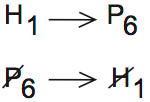
The first two rules are critical. Don’t just write them down. Think about what they mean.
The numerical distribution of messages Is important
There are six people, and six messages. Only one person can leave more than one message, and they can only leave three, at most.
For example, let’s say one person left three messages. We’d still need three other people to leave messages, for a total of four people. There are always at least four people in the game.
We could also have one person leave two messages, or six people could all leave one message.
So we have these scenarios for the number of messages left by different people. The numbers refer to the number of messages left by each person, not who left the messages:
- 3-1-1-1. (four people)
- 2-1-1-1-1 (five people)
- 1-1-1-1-1-1 (six people)
Make sure you understand the numerical distribution, and keep it in mind. It’s crucial for solving the game. I’ll discuss it more it more later, once we look at the rules about who can leave messages.
The third rule is important to remember, because it doesn’t connect with any other rules.
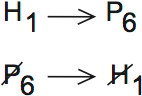
When I find a rule that can’t be connected, I will take a few seconds to consciously repeat it. I will also look at all of the rules again before starting the game. I want to burn them into my brain for eight minutes and forty-five seconds. If I forget that H being in first forces P into sixth, this game will be hard.
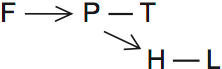
Now, for the in-out rules. If G is in, F and P are in.

The fifth rule makes the fourth rule partly redundant. If F is in, P and T are in.
So we don’t need to say that G causes P to be in. G forces F in, and F forces P in. We get a simpler diagram this way; there’s no need to say the same thing twice.

I’ve drawn a unique diagram for this game. F causes P and T to be in, but P is in front of T (If F is in).
So I’ve added a sequencing rule to the diagram. The line between P and T shows that P is before T when F is in.
Next, if P is in, then H and L are in, and H is before L.
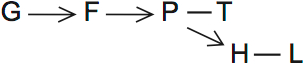
I’ve added the same sequencing rule as a reminder that H is before L when P is in.
There are other ways you could draw these rules, but this is the simplest way I’ve seen. Simple diagrams allow you to view all of the rules at once. And while you could draw the sequencing rules separately, why would you? This way, you can’t forget them.
Who can leave messages if there are multiple messages by one person?
Now, lets think about the numerical distribution. We need at least four people to leave messages. Let’s think about who doesn’t have to be in. We can have as low as four people leaving messages. If G is in, everyone is in. So if we have only four people, then G would have to be out.
If F is in, P, T, H and L are also in. That’s five people.
So if only four people leave messages, G and F are out. P, T, H and L are in. H is before L, but P and T can be in any order. The rule about their order only applies when F is in. Also, note that one person leaves three messages when four people are in.
If five people leave messages, then F is in, and one person leaves two messages. P does come before T in this scenario. If all six people are in, then everyone leaves one message, and all of the rules apply.
For clarity, the three scenarios are:
- Six people in, all the rules apply.
- Five people in: G is out, F is in and all the rules apply. One person leaves two messages.
- Four people in: G and F are out, one person leaves three messages. H is before L, but P doesn’t have to be before T.
If you understand the diagram and these three scenarios, the game is easy.
Go over the setup and try to draw things yourself if you’re still uncertain about any of this.
Game 2 Main Diagram
These diagrams show the rules used to determine the possible orders of messages that people left on an answering machine (F, G, H, L, P, T).
Refer to these diagrams when solving this game. Copy them on your own page, and on each question make a new version of them in order to follow along with my explanations. You’ll learn much more if you draw along.
The setup section explains how to build this diagram.
Rules
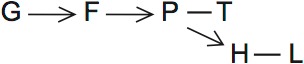
There are some rules not captured on the diagram. Ideally, you should just memorize these:
1. At most one person leaves more than one message.
2. Nobody can leave more than three messages.
Question 6
As with all list questions, use each rule to eliminate the wrong answers one at a time.
A is wrong because P’s messages have to be before T’s, when F is in (rule 5).
B is wrong. If G is in, F has to be in (rule 4).
C is wrong. If H leaves the first message, P has to leave the last message (rule 3).
D is CORRECT.
E is wrong because H and L both leave two messages . Only one person can do that (rule 1).
Question 7
If someone leaves two messages, then that means that five people leave messages. So F, P, T, H and L are in. P has to be before T, and H has to be before L.
A is CORRECT. This could be the order:

B is wrong. If H is first, P must be last (rule 3).
C is wrong. If L leaves the first message, then L is not before H. That can’t happen when P is in (which is always).
D is wrong because if P leaves the last message, then they therefore leave a message after T. That can’t happen when F is in (rule 5).
E is wrong because T leaves a message before P, if T leaves the first message.
Question 8
G leaves the fifth message. We know that if G leaves a message, then everyone leaves a single message. All of the ordering rules apply:
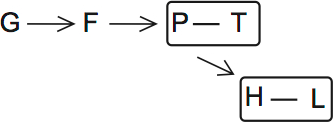
(I’ve circled them for emphasis only)
Since T has to come after P, T can’t go first. If T is first, T is automatically before P.
A is CORRECT.
Question 9
It’s easy to answer this question if you figured out the numerical distributions.
At least four people have to leave messages. One person could leave three messages, and three other people could leave a single message, for a total of six.
The four people that always have to be in are P, T, H and L. They could be the four who leave messages. Here’s one possible scenario, just as an example:

We can’t have less than four people, because no one is allowed to leave more than three messages.
This analysis eliminates A, B, C and E. We need L, T, H and at least four people.
D is CORRECT.
If G is in, then everyone leaves one message. Here’s a working scenario where G is in:

Question 10
P’s only message is the fifth message. So H can’t go first (third rule). This is the key deduction, and eliminates many answer choices.
L also can’t go in 2, because that would force H to go in 1.

If F is in, then P has to go before T, so the scenario is even further restricted.
F doesn’t have to be in though. So this diagram below is only for when F is in.
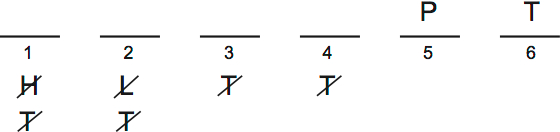
A is wrong because if H goes first, P must go sixth.
B is wrong. If T leaves two messages, then five people leave messages (2-1-1-1-1). That means F is in. If F is in, T must come after P.
But there’s only one space after P, so one of T’s two messages goes before P’s message.
C is CORRECT. This scenario shows how it could work:

D is wrong because H comes before L. So if L leaves the second message, H leaves the first. That won’t work: if H leaves the first message, P must leave the sixth message, not the fifth.
E is wrong because H would be forced to leave the first message.

T is after P, because F is in. H is before L, because that aways have to be true. But if H is in 1, P has to be in 6, not 5.
Game 3: Carwash
Game 3 Setup
This is an explanation of the third logic game from Section I of LSAT Preptest 30, the December 1999 LSAT.
Five people – Frank, Marquitta, Orlando, Taishah, and Vinquetta (F, M, O, T, V) – had their cars washed one at a time. Each of the cars received exactly one kind of wash: regular, super, or premium (r, s, p). You must determined the possible sequence based on the rules.
Game Setup
This game is a mix of sequencing and grouping. The rules tell us the order the cars are washed in, and they also tell us which type of wash each car receives.
It doesn’t really matter exactly what you call this type of game. I’ve never seen seen another quite like it. The most important thing is representing the rules in a way that makes sense, and combining them.
Here’s how to draw the first two rules. The first wash isn’t supreme, and only one wash is premium:

(It’s easiest to draw the wash types under the diagram)
You need a quick way to remember that 2 and 3 will always be the same. I find an arc joining the two works well:

The next two rules are sequencing rules. V is before O and T:

And M is between O and F:
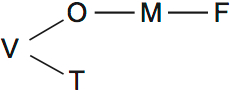
V goes first. There are only five cars, and T, O, M and F all come after V.
The fifth rule tells us (among other things) that there will always be at least some regular washes. So all three wash types have to be used: s, p and r.
Some people stop there, but we’re not done yet. It’s always worth looking at your most restricted variable and seeing whether you can make deductions.
In this case, M has two rules. M is between O and F, and the car directly in front of M has a regular wash.
We can only put M in two places. They can go third if T goes afterwards, or they go fourth if T goes beforehand. We should try both and see what happens.
Here’s what happens if M goes third:
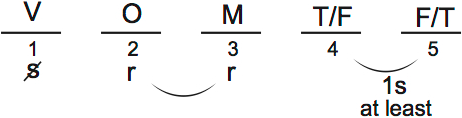
We need at least one super, and exactly one premium.
If M goes fourth, things are still pretty restricted. Car three has to get a regular wash, because the car in front of M always gets a regular.
Car’s 2 and 3 always get the same wash, so car 2 is also regular.
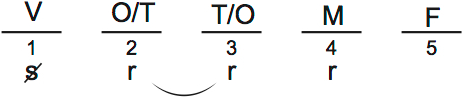
There’s more. Car 5 is the only car left that can get a super wash. That leaves car 1 to be the car that gets a premium wash.
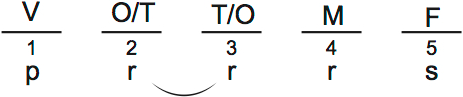
You’ll notice that O has to get a regular wash in both scenarios. This always has to be true, and that deduction answers question 15.
Game 3 Main Diagram
These diagrams show the rules used to determine the sequence and type of wash (r, s, p) the cars (F, M, O, T, V) received at a carwash.
Refer to these diagrams when solving this game. Copy them on your own page, and on each question make a new version of them in order to follow along with my explanations. You’ll learn much more if you draw along.
The setup section explains how to build this diagram.
Main Diagram
Scenario where M is in 3:
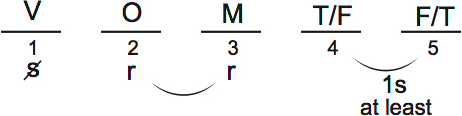
Scenario where M is in 4:
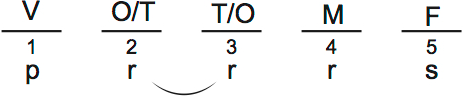
These two scenarios are extremely important; they cover all the rules. Make sure you understand how to make both scenarios. Try them on your own if you’re unsure.
The starting point is putting M in 3 or 4, then applying the rules.
Question 11
List questions are always easiest to answer by going through the rules one answer choice at a time.
A is wrong because O has to go after V.
B is CORRECT.
C is wrong because M has to go after O.
D is wrong because car 1 can’t get a super wash.
E is wrong because there needs to be at least one super wash.
Question 12
V’s car is always washed first. The first car can only get a premium or a regular wash. So the local rule for this question means that V’s car gets a regular wash.
We saw in the setup that if M is fourth, the first wash must be p. So we can’t use that scenario.
(if you’re unclear about this, review the setup, and make the scenario yourself. It will make more sense once you do that)
The scenario with M in 3 looks like this:
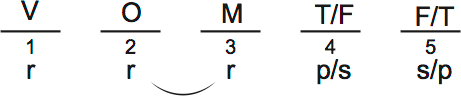
T and F go in either order at the end. One is p, and one is s.
A is CORRECT. Both O and V get regular washes.
B, D and E all can’t be true, based on the diagram.
C could be true, but the premium wash could also be 5th instead.
Question 13
We saw this scenario in the setup. Only when M is in 3 can we make cars 4 and 5 the same.
This is what happens if M is in 4:
No good, 4 and 5 are different.
Only the other scenario (M in 3) works:
We have to make the last two washes super to satisfy the local rule. They can’t be regular, because at least one wash needs to be super (rule 1). The first car becomes premium, because we always need exactly one p (rule 2).
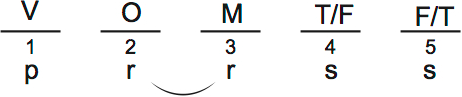
B is CORRECT.
The diagram shows that the other answer choices can’t be true.
Question 14
Questions 14 and 15 show that you were expected to combine the rules and make many deductions. They’re must be true questions without a local rule.
E is CORRECT. In either scenario, the second and third cars have to get regular washes.
This scenario (from #12) shows that A-D are wrong:
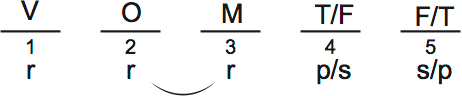
One of cars 4 and 5 get a premium wash, and the other gets a super. But it doesn’t matter which way things go. So:
A: V doesn’t have to get a premium wash.
B: It’s possible for only one car to get a super wash.
C: The fifth car can get a premium wash.
D: The fourth car can get a premium wash.
Question 15
There are two ways to do this. One way to solve this type of question is to make up front deductions in the setup. We saw there are only two scenarios:
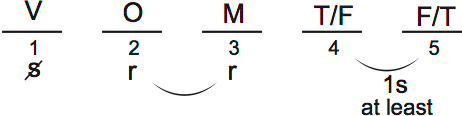
Along with M (who is in every answer), O’s car is the only one that always gets a regular wash.
B is CORRECT.
The other way is to use scenarios from past questions to disprove answer choices. For example, this scenario from question 13 shows that V, F and T’s cars don’t need regular washes:
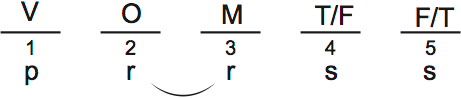
You may not find that your past scenarios eliminate all of the wrong answers on this type of question. But even getting rid of 2-3 is useful. You can then spend more time diagramming the remaining two.
Question 16
Adding J’s car creates many new possibilities. It’s not worth it to figure them all out, there are dozens of new scenarios.
The fastest and easiest way to solve this question is to try and make workable scenarios to eliminate the four wrong answers.
This scenario shows that B is wrong:

This scenario shows that C is wrong:

This scenario shows that D and E are wrong:

A is CORRECT.
Under the old rules, O could only be 2 or 3. In either case his car got a regular wash.
Now that J is here, O’s car can be washed 2nd, 3rd or 4th.
If O’s car is washed 2nd or 3rd, the wash can’t be premium. There’s still only one premium (rule 1) and the 2nd and 3rd cars get the same kind of wash.
Here’s an example:

If O’s car is washed 4th, O’s wash comes right before M’s, and that means they’re both regular (rule 6):

Game 4: Toy Trucks
Game 4 Setup
This is an explanation of the fourth logic game from Section I of LSAT Preptest 30, the December 1999 LSAT.
A factory with seven assembly lines will assemble seven toy-truck models (F, G, H, J, K, M, S). Each line will assemble exactly one model. You must determine the possible assignments of the toy trucks to lines.
Game Setup
This is a linear game, with a few sequencing rules. It can, and should, be drawn using two diagrams.
The first two rules are simple. Here’s how to draw them:

The lines between F – J tells us that F comes at some point earlier than J. MG are in a box so that we know M comes directly before G.
I draw the third rule on two diagrams:
(I added the 4th rule too)
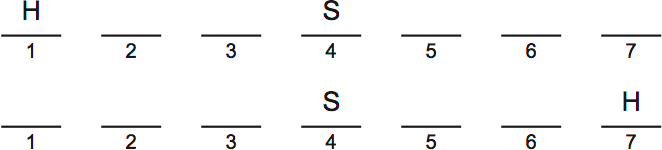
Drawing two separate scenarios makes the game easier to visualize. On individual questions, there are often different deductions for each diagram. You should reproduce this diagram for local rule questions.
It should only take 8-10 seconds to redraw the entire diagram, if done correctly. I often avoid drawing numbers, for example. This is a very common diagram, and not hard to get used to without numbers, if you try (I keep them in here because they make the explanations clearer).
8-10 seconds is well worth the benefit of having a full diagram.
That’s the whole setup. The only other thing you should note is that there are no rules for K. You can draw a circle around K in your list of variables.

Game 4 Main Diagram
These diagrams show the rules used to determine the possible assignments of the toy trucks to lines (F, G, H, J, K, M, S).
Refer to these diagrams when solving this game. Copy them on your own page, and on each question make a new version of them in order to follow along with my explanations. You’ll learn much more if you draw along.
The setup section explains how to build this diagram.
Main Diagram
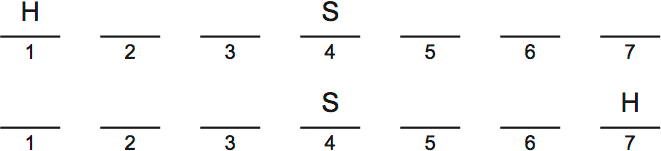
Rules


Question 17
Use the rules to eliminate the answer choices on this list question. Take each rule one at a time.
A is wrong because H needs to be first or last (rule 3).
B is CORRECT.
C is wrong because M has to be in front of G (rule 2).
D is wrong because S has to be in 4 (rule 4).
E is wrong because F has to be ahead of J (rule 1).
Question 18
To disprove wrong answer choices, you need to show that they could be false. So you have to put the trains on an earlier day than the one mentioned in the answer choices.
This diagram disproves A and D:

This diagram disproves B and E:

C is CORRECT. J has to come after F, so J can’t be assembled on line 1.
Question 19
This question is confusing. It’s asking whether we can put the two trains beside each other in either order. So A would be GH or HG, for example.
I found it useful to quickly draw new diagrams beside the question, with K in 5. Then I tested if the answer choices worked. Here’s what happens when H is in 1:

The MG and F – J could go on either side of SK, but the two blocs have to be apart, since MG fills up two spots.
Here’s what happens when H is in 7:

J has to go in 6, it’s the only way to fit MG in, and put F before J.
These two diagrams make it easier to eliminate the wrong answers.
A is wrong because G is on the wrong side of H in the first diagram, and there’s no space in the second.
B and D are wrong because MG and J have to be on opposite sides of SK.
E is wrong because K blocks M from being on the right hand side of S.
C is CORRECT. This diagram proves that J can go before H:

Question 20
The easiest way to test this is to place F and J as far apart as you can, and see whether everything works. The scenario from question 19 is a good example:

There are four spaces between F and J.
D is CORRECT.
The only way to get five spaces would be to place F and J on lines 1 and 7, but H has to go in one of those spaces.
Question 21
This is another question that’s helpful to draw. K is second, thanks to the local rule.
Here’s what things look like when H is in 7:

MG can only fit in 5 and 6. That leaves space for F to go in 1, and J goes in 3.

When H is in 1, we get this diagram:
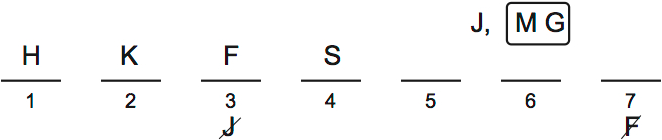
MG only have space to go in 5 and 6 or 6 and 7. F has to go in 3, because F goes before J.
In both cases, F is before S. A is CORRECT.
The first scenario proves B-E wrong.
Question 22
This new rule combines our first two rules:

Now look at the main diagram:
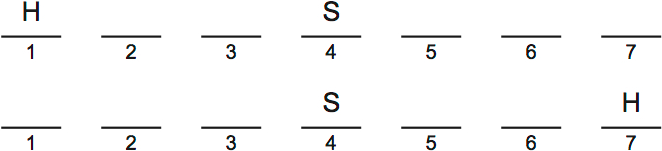
Only the second diagram has space to put MGF together and put J afterwards. We get this diagram.

J and K go in 5 and 6, in either order.
A is CORRECT.
Question 23
If M is assembled on line 1, we know 2 things. G is assembled on line 2 (rule 2) and H is assembled on line 7 (rule 3).

We have F, J and K left to place. F has to go before J.
A is wrong, because J has to come between F and H.
B is wrong. 5 and 6 are the only places we could put F and K together. But then J would be before F, in 3.
C is wrong. If J were in 3, beside G, then J would be ahead of F.
D is CORRECT. We could put K in 3, and F and J in 5 and 6.

E is wrong. There’s no way to put K in front of G. M goes in front of G.

Leave a Reply