
LSAT Preptest 29 LG Explanations
Full explanations for every question from the logic games section of LSAT Preptest 29.
Archived Logic Games explanations
Logic Games are no longer part of the LSAT. LSAC removed the Logic Games section beginning with the August 2024 LSAT. If you are studying for the current LSAT, you can skip this section.
These explanations remain available for students, tutors, and readers using old-format PrepTests. For current guidance, see Logic Games and the current LSAT.
Table of contents
Game 1: Bills
Game 1 Setup
This is an explanation of the first logic game from Section III of LSAT Preptest 29, the October 1999 LSAT.
An accountant needs to pay seven bills (1, 2, 3, 4, 5, 6, 7) over the next two days: Wednesday and Thursday (W, T). You must determine the possible payment schedule according to the rules.
Game Setup
This is a grouping game, and it illustrates a very important principle. Whenever a rule only allows two possibilities, you can split the game into two scenarios. This is always very useful.
The first rule lets you make two scenarios. Either three or four bills are paid on Wednesday.
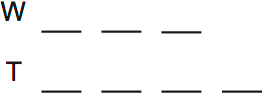
Or
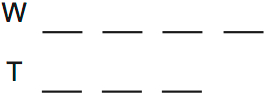
You should draw the second rule directly on the diagram. 1 and 5 are never in the same group. Since there are only two groups, that means one of them goes in each group.
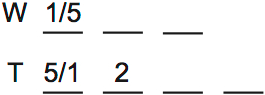
Or
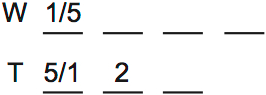
I’ve added in the third rule as well: 2 is always paid on Thursday. If you draw it directly on the diagram, you no longer have to waste mental space thinking about it.
By drawing the rule about 2 directly on the diagram, you can also combine it with other rules to make deductions.
For instance: rule four says that 4 and 7 always have to go together. On the diagram with four bills on wednesday, there is only one free space on Thursday. So 4 and 7 have to be paid on Wednesday.
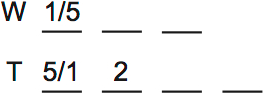
(Three bills on Wednesday)
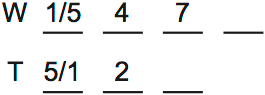
(Four Bills on Wednesday)
I’m building these diagrams two at a time because this is how I actually set up two scenario games on my own. It’s much faster, and the process is simple: place the rules on the diagram, and look for deductions by focussing on the areas with the most restrictions.
So now our diagram has rules 1-4. The final rule completes the second diagram.
If 6 is paid on Wednesday ➞ 7 is paid on Thursday.
The contrapositive is:
If 7 is paid on Wednesday ➞ 6 is paid on Thursday.
Since 7 is paid on Wednesday in the second diagram, 6 has to be paid on Thursday.
Only 3 is left to be paid, and they fill the last spot on Wednesday.
Or
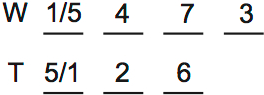
So we know almost everything if four bills are paid on Wednesday.
If three bills are paid on Wednesday, things are slightly more open ended. You must place 4 and 7 together on either Wednesday or Thursday. There will be two spaces left on the other day, and 3 and 6 have to go there.
Here are the two possibilities for placing 4 and 7 when three bills are paid on Wednesday.
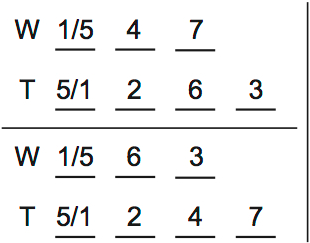
(Three bills on Wednesday)
And here’s the other scenario
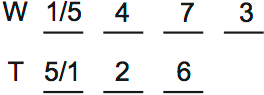
(Four Bills on Wednesday)
There are only three possibilities in this game.
- Three bills on Wednesday. 4 and 7 are on Wednesday.
- Three bills on Wednesday. 4 and 7 are on Thursday.
- Four bills on Wednesday.
The main point of uncertainty is where 1 and 5 go. They’re interchangeable, so either one could go on Wednesday or Thursday.
Game 1 Main Diagram
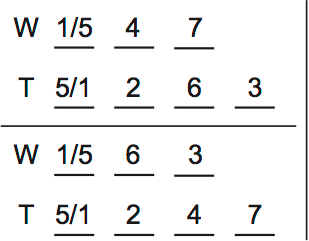
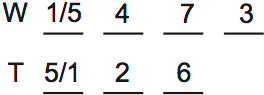
These diagrams show the rules used to determine the possible payment schedule (W, T) of the bills (1, 2, 3, 4, 5, 6, 7).
Refer to these diagrams when solving this game. Copy them on your own page, and on each question make a new version of them in order to follow along with my explanations. You’ll learn much more if you draw along.
The setup section explains how to build this diagram.
Main Diagram
Scenario 1 (Four bills thursday. 4 and 7 are interchangeable with 6 and 3)
Scenario 2 (four bills on Wednesday)
Question 1
This question is easy if you made the scenarios in your setup. Here’s the scenario when four bills are paid on Wednesday.
The right answer has to include 4, 7, 3 and one of 1 or 5. D is CORRECT.
You can also use the rules to eliminate wrong answers.
A is wrong because 4 and 7 aren’t together (fourth rule).
B is wrong because 1 and 5 are together (first rule).
C is wrong because 2 can’t be paid on Wednesday (third rule).
E is wrong because it puts 1 and 5 together on Thursday (since they aren’t paid on Wednesday).
Question 2
There are two ways to solve this. If you made scenarios, you can look at those and notice that every bill except 2 could be paid on Wednesday. C is CORRECT.
Or you can eliminate the answers using the rules.
We know both 1 and 5 can be on Wednesday. They’re always paid on different days, and they’re interchangeable. Interchangeable variables can go in either group. So A and B are wrong because they don’t include both 1 and 5.
D and E are wrong because 2 can never go on Wednesday (third rule).
Question 3
This is one of the scenarios from the setup. I’ll show you how to make it again.
Bill 2 is always paid on Thursday. That means that for this question, bill 6 is paid on Wednesday.
Thanks to the fifth rule, that means we have to put bill 7 on Thursday.
4 goes on Thursday too, since 4 and 7 are always together.
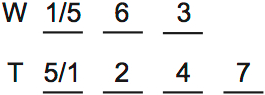
One of 1/5 goes on either day. 3 goes on Wednesday, since there’s no space anywhere else.
A is CORRECT. There are only three bills paid on Wednesday, otherwise it would be impossible to pay all the bills that must be paid on Thursday.
If you’re unsure how to make this diagram, practice drawing it yourself. Put 6 on the opposite day from 2, then see which rule that triggers. Go from there, one step at a time. You’ll reach the diagram I drew. This process of incremental deductions is a skill that is useful on all games.
This diagram is very important, actually. It solves questions 3-7! If you can draw it, the entire game is easy. So try drawing it.
B has to be false, from the diagram.
C and E are wrong because 1 and 5 are interchangeable. They can go on either day.
D is wrong because 2 and 3 have to be on opposite days in this diagram.
Question 4
This is the same scenario from question 3. If Bill 6 is paid on Wednesday, then 7 and 4 are paid on Thursday (the fourth and fifth rules).
B is CORRECT.
4 and 7 can’t go on Wednesday, so C and E are wrong.
1 and 5 can go on either day, so neither of them have to go on Wednesday. Therefore A and D are wrong.
Question 5
If bill 4 is paid on Thursday, then so is bill 7 (fourth rule). Bill 2 and one of 1/5 must also be paid on Thursday. It’s the same scenario from the last two questions.
There’s a reason I focussed on building scenarios in the setup. They’re extremely useful for this game.
A is wrong because 1 and 5 can never be together (second rule).
B is CORRECT. 7 has to be paid on Thursday, and 1 can be paid on either day.
C is wrong, 3 has to be paid on Wednesday.
D is wrong because both 3 and 6 have to be paid on Wednesday.
There’s no room for them on Thursday.
E is wrong because 6 has to be paid on Wednesday.
Question 6
A is silly. Bill 2 is always paid on Thursday (rule 3), so this answer choice adds nothing new.
We’ve seen scenarios where 3 is paid on Thursday too.
B is wrong. Bill 1 never has to go anywhere. It can be paid on Wednesday or Thursday, as long as Bill 5 is paid on the other day.
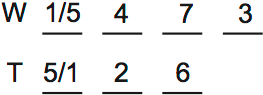
C is CORRECT. If Bill 4 is paid on Thursday, we’re in the scenario from questions 3-6. Bill 7 has to go with Bill 4, and that forces bills 6 and 3 to be paid on Wednesday.
This scenario proves D and E wrong:
Game 2: Mannequins
Game 2 Setup
This is an explanation of the second logic game from Section III of LSAT Preptest 29, the October 1999 LSAT.
Two mannequins (1, 2) will be dressed for display. There is a total of ten clothing articles. Each article is one of three colors: navy, red or yellow (N, R, Y). There are three jackets (J) – one in each color; three hats (H) – one in each color; three skirts (S) – one in each color and a red tie (T). You must determine the possible clothing combinations by using the rules.
Game Setup
This is a grouping game. Many students struggle to make a good diagram. But once you do get the diagram, it’s a fairly easy game.
First, I’d like to clear up a common point of confusion. There is exactly one of each type of clothing. If one mannequin wears the red hat, the other mannequin can’t wear it.
Second, the most important thing on any game is how to set up the main diagram. That’s especially true on this game, but many students rush to start drawing rules without thinking about how to draw the rules. They get a bad diagram, and get questions wrong.
So read over everything first, and then decide how to set things up.
The first question often gives you a clue. Notice that in the answers, the mannequins are vertical, and their clothing is horizontal.
…that’s hard to describe, so I’ll just show you a picture.
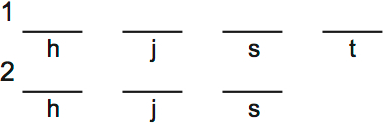
There are our two mannequins, and the clothing they wear. Number 1 is on top, with the tie.
I’m going to start with rule 2. There’s very little you can do with rule 1 right away. It’s not very useful to draw rules in isolation.
Often you can combine rules such as the first rule later, once you’ve drawn the other rules (in this game, you can). There’s no need to do the rules in order.
So, rule two says that the hat and the jacket are never the same color. You need something on your diagram to remind you, or you might forget.
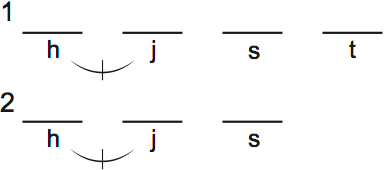
I like an arc underneath h and j, with a line through it (see the diagram).
If you draw the rules directly on your diagram, it’s very hard to forget the rule. Students frequently forget their rules – you need a mechanism to prevent this.
Draw the last two rules first
The last two rules are easy to draw. That alone is good reason to draw them before drawing the first rule.
Mannequin 2 wears the Navy Skirt.
Mannequin 1 wears a red tie because the tie only comes in one color…red.
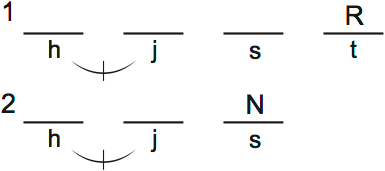
Be specific. What colors can’t the mannequins wear?
Now we can do something with the first rule. The mannequins can’t wear all three colors. Mannequin 1 is already wearing R, so this means he can’t wear Y and N are the same time.
Mannequin 2 is already wearing N, so this means mannequin 2 can’t wear Y and R at the same time.
It’s best to draw these deductions directly on the diagram, too.
The double arrows with a line in the middle mean that the mannequins can wear one but not both of the listed colors.
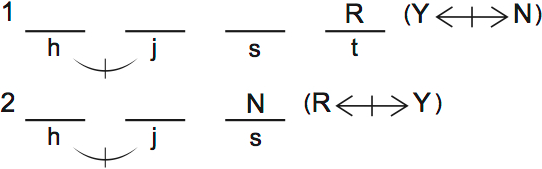
The diagram instantly shows all the rules
Now we’re getting somewhere. This tiny little diagram shows all the rules.
Being slow to remember rules is the biggest problem most people have with logic games. This diagram lets you see all the rules at once, once you understand the symbols.
It’s still useful to keep the rules in mind of course. You will work through the game faster if you commit to memory these two facts:
- The hat and jacket are different.
- No mannequin can wear all three colors.
We can make one more deduction. What colors can the hat and jacket be? They have to be different colors – but on mannequin 1, for example, they can’t be Y and N. Then the mannequin would wear all three colors. So either the hat or jacket is R, and the other is Y or N.
For Mannequin 2, either the hat and jacket will be N, and the other will be R/Y, for the same reason.
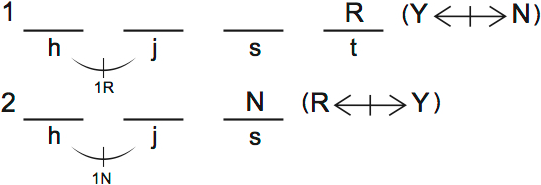
So here is the final diagram. It has every rule, plus an important deduction. If you draw this diagram, and you understand what it means, then the game is easy.
If you’re not sure what it all means, then don’t go on to the questions yet. Reread the rules, and reread my setup. Try drawing the diagram yourself.
These symbols are very powerful for solving logic games, but learning them is like learning a new language. It takes a bit of effort, but you’ll be amazed at what you can do with it once you learn it. And it’s not as hard as you’d think.
Game 2 Main Diagram
These diagrams show the rules used to determine the possible clothing (hat, jacket, skirt, tie) and color combinations (red, yellow, navy) of the mannequins (1, 2).
Refer to this diagram when solving this game. Copy it on your own page, and on each question make a new version in order to follow along with my explanations. You’ll learn much more if you draw along.
The setup section explains how to build this diagram.
Main Diagram
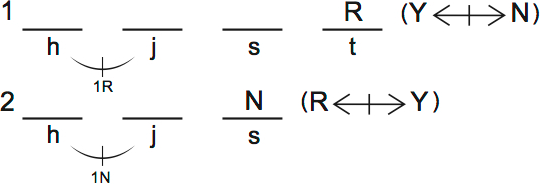
Question 7
This is a list question; just like the first question of most games. It’s usually easiest to solve these by taking each rule and applying it to the answer choices. Generally you can eliminate one answer choice per rule.
A is wrong because mannequin 1 is wearing all three colors (rule 1).
B is wrong because mannequin 1 is wearing a red hat and jacket (rule 2)
C is wrong because mannequin 2 needs to wear the navy skirt, not the yellow skirt (rule 3)
D is CORRECT.
E is wrong because mannequin 1 is wearing a yellow hat and jacket (rule 2) and also because mannequin 1 is not wearing the red tie (rule 4).
Question 8
This question depends on applying the rules and deductions from the main diagram, so here it is again.
A is wrong because mannequin 1 would be wearing all three colors: N, Y and R (the tie).
B is wrong because a mannequin’s hat and jacket have to be different colors (rule 2).
C is wrong because mannequin 1 has to wear either the red hat or the red jacket. Otherwise his hat and jacket would either be the same color, or Y and N.
The latter wouldn’t work because the mannequins can’t wear Y, N and R at the same time.
D is wrong because mannequin 1’s hat and jacket would both be yellow (rule 2).
E is CORRECT.
Question 9
This question gives us another local rule, and you should always draw local rules.
(Scroll down for diagrams + explanation)
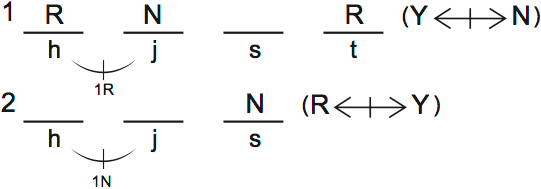
If Mannequin 1 wears the N jacket, then they must wear the red hat, thanks to the first and second rules.
One of Mannequin 1’s hat or jacket always has to be red, otherwise they would wear all three colors.
This means A and B are wrong. Mannequin 1 can’t wear yellow, because they are wearing red and navy.
C is wrong because Mannequin 1 must wear the red hat. So Mannequin 2 can’t wear it.
D is tricky. There’s normally nothing wrong with Mannequin 2 wearing a yellow hat.
It’s the jacket that’s the problem. It can’t be yellow, because the hat and jacket must be different colors. The jacket can’t be navy, because mannequin 1 is wearing the navy jacket.
And the jacket can’t be red, because then mannequin 2 would be wearing all three colors.
E is CORRECT.
Question 10
Everything must be red! Or at least, we have to use all of the red.
Start with what is certain. Mannequin 1 has to wear the red skirt, because mannequin 2 already wears the navy skirt.
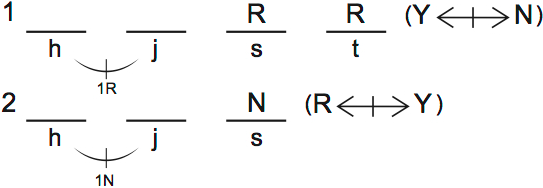
Only the hats and jackets are left. Each mannequin will wear one red hat or jacket.
Mannequin 2’s hat and jacket must be red and navy.
Why? Mannequin 2 already wears navy. They can’t wear red and yellow for their hat and jacket, because then they would wear all three colors.
E is CORRECT.
Question 11
If Mannequin 2 wears a red jacket, their hat must be navy. If their hat were yellow, they’d be wearing all three colors.
(Scroll down for diagrams + explanation)
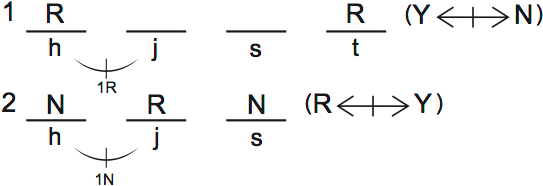
This forces mannequin 1 to wear the red hat. One of mannequin 1’s hat or jacket must be red. (Otherwise they will wear all three colors, or wear the same color for their hat and jacket)
B is CORRECT.
A and C must be false.
D and E could be true, but don’t have to be. Mannequin 1’s skirt could be any color, depending on the color of their jacket.
Question 12
This is similar to question 10. Mannequin 1 has to wear the yellow skirt, because mannequin 2 is already wearing a navy skirt.
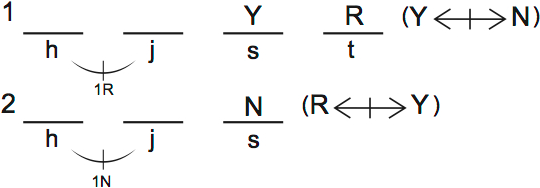
One mannequin will wear the yellow hat, and the other wears the yellow jacket.
We can’t have the mannequins wearing all three colors. Mannequin 1 is wearing yellow, so their hat and jacket must be red and yellow (in either order).
Mannequin 2 is wearing navy and yellow, so they can’t wear a red hat or red jacket.
Here’s one way to arrange things. But know that you can reverse the colors of the hat and jacket (e.g. RY or YR for mannequin 1).
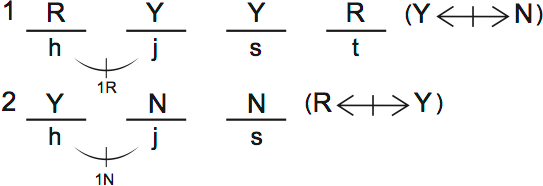
B is CORRECT. Mannequin 1 can wear the yellow jacket, and red hat, or vice-versa.
A is wrong. If mannequin 1 wore navy, he would be wearing all three colors.
C is wrong. Mannequin 1 needs to wear the yellow skirt, because mannequin 2 can’t.
D and E are wrong because mannequin 2 can’t wear red for this question. They’re already wearing navy and yellow.
Question 13
Mannequin 1 can only wear a red or a yellow skirt. That means there are only two possibilities for this question.
I found this question difficult to solve without drawing local diagrams, but easy to solve once you draw them.
Here’s what happens if mannequin 1 wears a red skirt.
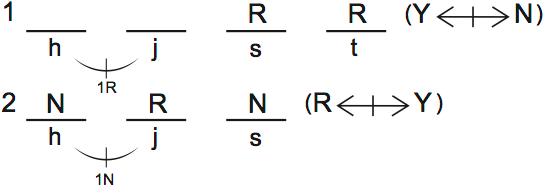
Mannequin 2 wears a red jacket to match. So they also wear a navy hat, because they can’t wear all three colors. We can’t say much about mannequin 1’s hat and jacket.
Here’s what happens if mannequin 1 wears a yellow skirt.
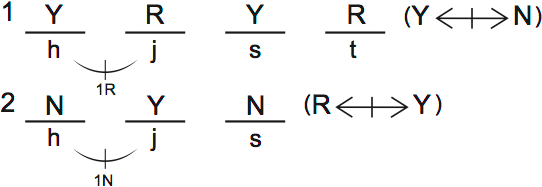
Mannequin 2 wears the yellow jacket to match, and they’re forced to wear a navy hat. Otherwise they would wear all three colors.
Mannequin 1 has to wear a yellow hat and red jacket. Why? They can’t wear navy, because they’re already wearing yellow and red. And Mannequin 2 is already wearing the yellow jacket, so only red is left.
The only thing that both diagrams have in common is that mannequin 2 always wears the navy hat. C is CORRECT.
A is wrong because Mannequin 1 doesn’t have to wear the yellow hat in the first diagram. B, D and E are proven wrong by the second diagram.
Game 3: Awards
Game 3 Setup
This is an explanation of the third logic game from Section III of LSAT Preptest 29, the October 1999 LSAT.
Seven language awards will be presented by a college dean. The awards are for research in French, German, Hebrew, Japanese, Korean, Latin and Swahili (F, G, H, J, K, L, S). The awards must be presented consecutively, only once, one at a time.
Game Setup
This game is a mix of linear and sequencing. By combining the rules, we can see that this game is very restricted.

The main diagram should have seven spaces. I’ve added the first rule: G can’t go first.
Here are the next two rules. H is before K, and L is before J.

We can combine the fourth and fifth rules with these. F is beside H and K is beside L:

I’ll explain what this picture means. The box shows F and H go beside each other, and the handle on top shows that their order is reversible. Think of it like a suitcase handle — you can pick up the box and turn it around.
So  means FH or HF. The same is true of KL.
We know H is before K. So FH must be before KL. And KL is before J, since K is before J.
Simple, right? You can draw the whole game with one simple line. Just remember that G can’t go first, and S can go anywhere.
Game 3 Main Diagram
These diagrams show the rules used to determine the possible sequence of the awards (F, G, H, J, K, L, S).
Refer to these diagrams when solving this game. Copy them on your own page, and on each question make a new version of them in order to follow along with my explanations. You’ll learn much more if you draw along.
The setup section explains how to build this diagram.
Main Diagram

Rules

S is random
Question 14
It’s rare for a game not to start with a list question. If there’s no list question, it’s often a sign that you were supposed to combine the rules and make deductions.
In this case, our diagram makes it obvious that A is CORRECT. F comes before J.
The other answers involve G and S. Those awards can go practically anywhere, as long as G doesn’t go first.
Question 15
We know from our diagram that KL and J have to come after H. So if H is fourth, KL and J fill the three spaces afterwards, and F goes third.
S goes first, because G can’t.

A is wrong because there’s no space for F after H.
B is wrong because F has to go third.
C is wrong because there’s no space for J in 6. L or K goes sixth.
D is wrong because L could also go in 5.
E is CORRECT. KL – J go after H, F goes beside H, and G can’t go first.
Question 16
You should always draw local rule questions, and this is no exception.
If G is third, only FH can go 1st and 2nd. KL and J can’t go first, because they go after FH.
And S can’t fill spots 1 and 2 on it’s own.
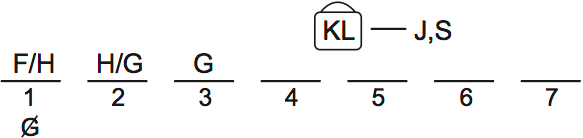
I’ve drawn KL – J, S above the diagram. I find this is a quick way to remind myself of which variables go after G. The comma indicates that there’s no rule.
So if I had written “A, B, X” it would have meant that A, B and X come after G, in any order.
If I write “A-B, X” it would mean that A comes before B, but X can go before, after or in the middle of them.
Try it yourself. It’s an easy way to remember the rules and to see which variables go where.
A is wrong because F has to go in 1 or 2.
B is wrong because KL go before J. J can be presented sixth, at the earliest.
C is CORRECT. J can go sixth or seventh.
D is wrong because F or H goes second.
E is tricker to eliminate. If you put S fifth, the only open spaces are 4, 6 and 7. You need two spaces to place KL, but they have to come before J. So putting them in 6 and 7 won’t work.
Question 17
The main diagram makes this easy.

There are four variables in front of J. So J can go fifth at the earliest. This diagram shows one way things could work.

C is CORRECT.
Question 18
We have a new rule, and we should draw it.

What does this tell us? F or H has to go first, since G can’t.

A is CORRECT. G would be first if it went before F.
This diagram proves B could be true.

This diagram proves C, D and E could be true.

If this game is still not intuitive, practice visually flipping the boxes in the main diagram. You need to know that KL could be LK. Once you understand that symbol intuitively, it’s very powerful.
Question 19
I hate this question. Not only is it hard, but it’s tough to explain. This is one of the hardest questions on the LSAT, so bear with me.
It’s very possible to do this question slowly, of course. You might have eventually figured out how to do it by drawing all the possibilities. But that’s not useful when you only have 8:45 to do the game.
Think of all of the variables that have to be locked down to determine the order:
- FH
- KL
- G
- S
To be useful, an answer must lock as many of these into place as possible. Each answer gives us two new conditions.
To lock everything into a fixed position, each new condition in the answer has to take care of two things from that list.
So if a condition tells us H is before F, that’s not very useful. It only takes care of one thing from the list.
Telling us that H is before L is useful. It gives us this order: FHLK.
We took care of two things from the list at once.
A is not useful, for example. It tells us that K is before L. That only affects one thing from the list.
B is also not useful. If H is before K, that automatically means F is before H. So the first condition was wasted.
C takes care of FH and KL, but it doesn’t tell us where to put G and S.
D does it. If G is before F, that means G is before this entire chain:
S must go first, because G can’t go first.
If G is before F, we know F is before H. So far, we have:
S – G – F – H
The second condition tells us that L is before J. That also tells us that K is before L.
Since K is after H, we get this order:
S – G – F – H – K – L – J
D is CORRECT.
E doesn’t do the trick. It’s not useful to tell us that H is before F, that only deals with one condition from the list.
Game 4: Piano Classes
Game 4 Setup
This is an explanation of the fourth logic game from Section III of LSAT Preptest 29, the October 1999 LSAT.
There are six piano classes to be held in a day. Nine students will attend these classes. There are four females – Gimena, Holly, Iyanna, and Kate (G, H, I, K) – and five males (M) – Leung, Nate, Oscar, Pedro, and Saul (L, N, O, P, S). Each of them will attend exactly one class. Two piano classes will have more than one students and four classes will have exactly one student.
Game Setup
This game is a mix of grouping and sequencing. We have to order the variables and say which of them go together in a group.
I draw games for speed and efficiency. I rarely find it useful to draw rules in the order they’re presented.
I start with simple rules, then focus on rules that can be combined with them.
It’s easiest to explain by example. The first rule is the simplest:

IL are a group.
There’s nothing we can do with the second rule right away, so we should ignore it.
K is the first female. That means she goes before IL (Iyanna is a female).
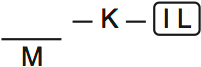
K is not the first student, so some male goes before her. We don’t know who.
The fourth rule lets us connect the second rule to the rest of the diagram. So now we can add the second rule. I try to draw things only once, if I can.

The fourth rule says that G comes after IL but before P. And the second rule tells us P is in a group with 2 other people.
We can add a few other things. H must come after K, because K is the first girl.
The last rule tells us that O is after G.
Now, who can be the boy(s) that goes before K?
There are five boys: N, S, P, L, O. Everyone but N and S come after K. So the only boys that can go before K are N and S.

Make sense? We need at least one boy before K, and only N and S are free.
That diagram above is the main diagram. But we still have to figure out who can go with P. I’ll show you a few sample scenarios to clarify how this game works in practice. (next page)
We know there are six classes (the first sentence of the setup). If you count up the different classes on the diagram, you’ll see there are seven groups. That’s too many.
But there’s no mistake. This just means that two of the groups will be merged: either 0 or H will go with P. Here’s how to draw it:

One of O and H goes with P, and so does one of N and S.
I left the other H and O on the diagram. It’s not a problem to repeat variables, as long as you understand what they mean. Obviously if H is in the class with P, for example, then there’s no separate class with H alone. It would look like this:

I didn’t draw that separately when I did the game myself, because it seemed more effective in this case to show the different possibilities within the same main diagram. But feel free to draw the separate diagrams.
Another possibility is that both O and H go with P. We still have one of N/S left to place. They can go anywhere. It’s even possible to put both N and S before K.

The circle around N/S means that they are random. One of either N or S can go anywhere.
Game 4 Main Diagram
These diagrams show the rules used to determine the possible assignment of classes to students (G, H, I, K, L, N, O, P, S).
Refer to these diagrams when solving this game. Copy them on your own page, and on each question make a new version of them in order to follow along with my explanations. You’ll learn much more if you draw along.
The setup section explains how to build this diagram.
Main Diagram
This diagram has the potential for confusion, because it repeats O and H. One of them goes with P. If that happens, it doesn’t go anywhere else. For instance, the H after K means exactly that: H is somewhere after K. So if H is with P, it’s automatically after K.
Scenario 1 (One of O/H goes with P, and that means they won’t be after K or G, respectively.)

Scenario 2 (The second N/S is random, and can go anywhere, as long as one goes before K)

Question 20
The first question is not a list question. This is very rare. It’s almost always a sign the LSAC was expecting you to combine the rules into one diagram.
It’s true here. From our main diagram, we can see that only N or S could go first.

None of the girls can go first (third rule) including H, so A is wrong.
B is wrong because L is with I, after K.
C is wrong because O comes after G (fifth rule)
D is wrong because P comes after G (fourth rule)
E is CORRECT. Either S or N can go first.
Question 21
There are a couple of ways to solve this. The easiest is to eliminate answers.
P comes after G. So G can’t be the last (sixth class). Any answer with “sixth” is wrong; we can eliminate B and D.
We also know that N/S, K and IL are before G. So G can be fourth at the earliest. C and E are wrong because they say G can go second.
A is CORRECT.
This scenario shows how G can go fourth or fifth.

If we put the spare N/S in front of G, G is fifth. If we put N/S after G, G is fourth.
Question 22
The only people that can ever go with P are O, H and one of N/S.
That’s enough to eliminate A, C and D. (G, K and L can never go with P.)
E is tempting. But N and S can’t both go with P. One of them has to go before K.
B is CORRECT. This diagram shows you how it could go.

Question 23
If O is not with P, then our diagram looks like this:
(Scroll down for diagrams + explanation)

H and one of N/S has to go with P, since no one else can.
The other N/S, K, IL and G all go before P.
A is wrong because both O’s class and P’s class come after G. So G is fourth.
B is wrong because H has to go with P.
C is wrong because G, O and P come after IL. So IL is third.
D is CORRECT. N could go with P, and P could go either fifth or sixth, depending on O.
E is wrong because one of N/S goes before K and the other goes with P. S is either first, fifth or sixth.
Question 24
Many people freak out when the LSAT asks them to redraw a diagram. I’ve never understood why. Just remove the old rule, then draw in the new one.
If you’re afraid to redraw your diagram, then you don’t understand it well enough. Changing a diagram should be like changing the words in a sentence you wrote.
You need to understand these logical symbols the way you understand a language.
I’ll show you how to change this, in two steps. First, erase the line that connected G and O.

Second, add a new line that shows O is after K, and before G.

Done!
Well, almost. Now we have to see if there are any new deductions.
Who can we put with P? Now only H and one of N/S are free to go anywhere. So they have to go with P.

So, from our diagram above, we can see H has to go in the last class, with P. E is CORRECT.
When I said you need to understand these symbols as well as you understand written language, I meant it.
Practice turning statements into diagrams and combining them. Do it until it’s second nature. Then logic games will be much easier.

Leave a Reply